Some facts about Israel that you may not know

For those who are wondering why Israel can always get away with their massive crime, and why Gaza doesn’t have the proper military equipment to fight back, here’s some facts about Israel that you may not know:

Israel receives $3 billion aid from the US government each year since 1985, the majority of which goes into military.

The majority of UN member countries have tried to sanction, condemn or label Israel’s action as illegal at the UN Security Council, but the US (with their veto power at the UN) has vetoed every single UN resolution that are critical to Israel, which let them to get away with every crime they conducted. Here’s the full list of the vetoes on Jewish virtual Library.

Every single US president and politician have pledged their undying commitment for Israel, simply because in US politics Jewish Lobby (called AIPAC) is very powerful, the king maker. To go against Israel and AIPAC is a political-career suicide. So the real criminals behind the Apartheid state of Israel is AIPAC. “The Israel Lobby and U.S. Foreign Policy” by John J. Mearsheimer and Stephen M. Walt is one of the best books that explains AIPAC.

Now this is very important: not all jewish people in Israel (and all over the world) support this aggression. The problem is not with jewish people, but with Zionism. The movement began to get a serious boost ever since the Balfour Declaration 1917, where the British government declared their support for Zionism, in order to gain counter-support from the large Jewish community in Britain for their increasingly unpopular military actions during World War I. This is one of many jewish movements that are against zionism: True Torah Jews.

Some media try to portray the Gaza aggression as the clash of two equal powers between Israel and Hamas (from inside Gaza). However, while just few miles away Israelis live in a 1st class world, Gaza has been shut down from the outside world by Israel since 2006 and has been deliberately kept close to malnourishment (so they become weak and unable to fight back).

And this is how the very core of the Palestinian economy is destroyed by Israeli and US neoliberal policies.

Israel has top class military equipments, including nuclear weapons, while Hamas has to smuggle their weapons and small rockets into the open-air-prison of Gaza (smuggled from the Rafah Crossing in Egypt border). Israel has iron dome to shield itself from these rockets while Gaza, as we have seen, can be bombed easily.

And then there’s Egypt’s role in all of this. The rise of Hosni Mubarak to power in Egypt through CIA-engineered assassination of president Anwar Sadat in 1981, has made Egypt the bodyguard for Israel (US pays Egypt $1.3 billion annually to safeguard their bordering neighbour). When Mubarak stepped down in 2011 Egypt had a glimpse of democracy, with Mohamed Morsi from the Muslim Brotherhood was democratically elected as the new president. The problem was, Muslim Brotherhood had ties with Hamas and tend to be pro-Palestine, and so after a brief experiment with democracy Mohamed Morsi was ousted by a military coup and jailed for life. And the newly-installed dictator General Abdul Fattah Al-Sisi is, surprise surprise, pro-Israel.

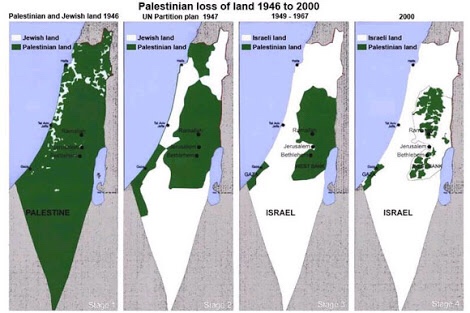
In theory, Israel and Palestine have made several peace agreements in the past, with the Oslo Accord 1993 as the most serious one. Here’s Israel’s many violations of the Oslo Accord.

The quickest way to destroy a country is through a direct war and through destroying its economy. If you want Israel to be hold accountable for its violation of International Law, this is what you can do. There’s actually an app to help you with the boycott.

Just a feedback on whether boycott movement works: in 2009 Israeli exports was hit by European boycotts after Israel attacked Gaza.
What the world media say about Indonesian election

When reading any last-minute news about the election tonight, just remember that despite the claim of free press since 1998 Indonesia is ranked 132 out of 180 countries in World Press Freedom Index 2014, with limited news selections from either biased tycoon-owned media, or conspiracy theorists on their social media accounts / Kompasiana.

There’s often no distinction between facts, opinions and interpretation of facts (which is an opinion), where we often ended up reading viral info that are almost impossible to verify the authenticity. Black campaign, especially tonight, is spreading like wildfire.

Don’t buy into it, be much smarter than that. Instead, here’s what some of the most respected media from around the world have to say about tomorrow’s election, to help us have a better judgement:

The Guardian

Al Jazeera English (video report)

Bloomberg

The Economist

Mother Jones

WikiLeaks Cable

The New York Times

South China Morning Post

Australian Broadcasting Corporation

Time Magazine

The Wall Street Journal

Financial Times

Foreign Policy

And concluded by the ever brilliant

New Mandala

Indonesian presidential election: the candidates in a nutshell

The first method for estimating the intelligence of a ruler is to look at the men he has around him – Niccolo Machiavelli

Remember that by voting for 👆Prabowo or ✌️Jokowi, we’re not only voting for the presidential candidate but also their coalition. Here’s 10 pointers to consider for tomorrow:

1. Among those behind Prabowo there’s the likes of Hatta Rajasa, Aburizal Bakrie and PKS. So for example if you want Ical to be the main minister (as per their coalition arrangement) and PKS’ Tifatul Sembiring to potentially remains as Menkominfo, vote for Prabowo.

2. Among those behind Jokowi there’s the likes of JK, Anies Baswedan and Alwi Shihab. So for example if you want Anies Baswedan to potentially becomes education minister and Alwi Shihab potentially back as a minister, vote for Jokowi.

3. Despite their carefully-crafted populist image, both candidates still have an unavoidable list of “rent-seeking” businessmen’s interests behind them. It’s how democracy really works in the past 30 years, from Koch brothers in the US to Roman Abramovich in Russia, where they “purchase” national regulations that benefit their businesses and tend to win projects without tenders. Just look at the current richest person in Indonesia right now, and you’ll see why he jumped the wealth ladder during SBY’s presidency and was chosen to fill a strategic ministerial position.

4. Although both coalitions have Islamic party backing, their interpretation of Islam are slightly different. In Jokowi’s side there’s the slightly more liberal PKB with their Nahdlatul Ulama base. While in Prabowo’s side there’s PAN which inclined to a more conservative Muhammadiyah and PKS with its more hardline Wahhabi ideology, with PPP as the complicated exception.

5. Jokowi may be a proxy, or even a puppet, for Megawati. But the worse political godfather is arguably in Prabowo’s camp, in the name of Amien “poros tengah” Rais. Conversely, Prabowo is accused of being a human rights violator based on what happened in 1998, but if the accusation ever to be proven then his superior Wiranto (in Jokowi’s camp) should be prosecuted too due to his position during the “operasi mawar” and his role in Timor 1999. On that last note, if Jokowi wins, the riot 1998 case (on Wiranto) would likely to remain silenced. If Prabowo wins, the following cases would likely to remain untouched: riot 1998 (on Prabowo), Hajj fund corruption (Suryadharma Ali), beef import scandal (PKS), Lapindo brantas (Aburizal Bakrie), Oil Mafia (Hatta Rajasa), Bank Century (Demokrat).

6. When reading any news about the election, just remember that despite the claim of free press since 1998 Indonesia is ranked 132 out of 180 countries in World Press Freedom Index 2014, with limited news selections from either biased tycoon-owned media, or conspiracy theorists on their social media accounts / Kompasiana. Remember that opinions are not facts. An interpretation of facts is also an opinion, not a fact. And remember that even facts can be manipulated, e.g. All of these polling numbers that rarely disclose the data number of respondents and their demographic compositions that could reveal their bias.

7. Prabowo declares his commitment to continuing the programs of SBY’s government, which prompted the late official support from the Demokrat. This coincidentally includes how the ministerial positions are distributed among the coalition partners, while conversely Jokowi declares that he will appoint professionals in each posts. Hence, in short, if you like the way things are under SBY’s presidency, vote for Prabowo. If you want change, whether for the better or worse, vote for Jokowi.

8. As they say in Uganda, the flies may change but the shit remains the same. Remember that both coalitions still have some New Order regime people in it, a hint that Indonesia might not have a regime chance after all, only a “change of clothing.” This may explains why Suharto was never really prosecuted and why the truth about the dark history of our nation during the New Order (1965 coup, 1998 riot, etc) never truly revealed. For a comparison, there’s no Saddam’s people in the current Iraqi government and we wouldn’t dream of having Gaddafi’s people in the new Libyan government, both of whom were ousted and didn’t step down like Suharto or Mubarak.

9. Whoever you vote for, and whoever wins, the new president will inherit a tough budget and would likely to have a hard time in fully implementing his plans due to no majority seats in the parliament (353 seats for Prabowo camp, 207 seats for Jokowi camp), which would ensure another DPR freak shows. So this election outcome would probably not be the “quick fix our country urgently need”, but instead it’s another one step forward on a long and complicated journey.

10. But most importantly for me, for die hard supporters out there please win with humility and lose with dignity. And keep calm. There’s nothing more effective for a ruthless/incompetent leader, and nothing more disastrous for the majority of the people, than fiery blind followers. Be it Al Qaeda militants, Nazi soldiers, North Korean citizens or presidential supporters who worship their candidate as some kind of god who can do no wrong. Switch-on your bullshit alarm, always be critical to every candidate and for the love of our nation please don’t get easily provoked. With election outcome likely to be won in the tiniest of margins, high tension and clashes amid election result are highly possible.

Indonesian presidential election: When 9 July comes

He may not be a philosopher-king, but when 9 July comes I’ll vote for Jokowi. It’s not that I blindly adore him and got carried away by all of the PR-engineered hype of him, but because to me he’s a better option than the other candidate: a coalition of hardliners led by 3 psychopaths.

Let me explain what I meant by psychopaths. Psychopathy is defined as “a personality disorder characterised by enduring antisocial behavior, diminished empathy and remorse, and disinhibited or bold behaviour”, and each one of the main individuals in Prabowo’s camp, with their own problems, show these tendencies. First there’s Prabowo himself, an alleged human rights violator with mafia-esque short temper. Then there’s Hatta Rajasa as his VP, who’s involved in oil mafia (one of the biggest corruption acts in the fuel-subsidised country) and Aburizal Bakrie, who’s responsible for Lapindo mudflow disaster and who has a bad reputation in business, including that famous case where he duped Nat Rothschild.

Behind them lies 3 Muslim hardliner parties, where PPP’s chief Suryadharma Ali is involved in Hajj fund corruption scandal, PKS (a Wahhabi hardliner) is guilty of beef import corruption scandal that made beef prices expensive in Indonesia, and PAN with godfather Amien “poros tengah” Rais arguably the most backstabbing politician in the republic. Speaking of hardliners, the religious thugs FPI and “former” Jakarta gangster Hercules also declares their support for Prabowo, with the latter even runs Prabowo’s campaign operations on the street levels together with other network of gangsters. It seems that all the crooks and the thugs somehow found each others in this coalition.

Furthermore, Prabowo’s coalition is fundamentally based on money politics and political contract that ensures ministerial and province-level jobs are distributed among the parties (with Golkar party reportedly will get 7 ministerial positions). This is the same kind of disaster occurring right now in the incumbent Yudhoyono’s cabinet, where the majority of ministerial positions are not filled by professionals but rather controlled by coalition party members, which as a result our internet is among the slowest in the world and our once mighty sports national teams now’s a joke, to name just two cases out of many. And FYI the absolute majority of Yudhoyono’s current coalition members are all in Prabowo camp, with Jokowi’s PDI-P serves as an opposition party.

By contrast, Jokowi promises that if he gets elected all of the ministerial positions will be filled by professionals only (though some degree of ministerial post distribution among his coalition partners is still highly expected). Moreover, I like the people in his campaign team, with the likes of Anies Baswedan (an education reformer) and Alwi Shihab (a brilliant ex minister). His coalition’s economic plans is also more realistic compared with the unrealistically ambitious plan by Prabowo’s coalition who will increase the country’s debt-to-GDP level from around 28% right now to 50% to pay for all of their plans, but then at the same time vow to pay-off all of Indonesia’s debts (down to 0% of debt-to-GDP) by 2019, exactly the time his potential 1st term would have ended.

Moreover, Jokowi’s nomination of Jusuf Kalla (JK) as his running mate helps, just look at the incumbent Yudhoyono’s presidency when JK was his VP: his 1st term was highlighted with great reforms, swift decisions and conflict solutions; which granted Yudhoyono with high approval ratings and re-election. But then he dumped JK as his no 2, and his 2nd term has since regarded as a national joke with all the religious violence, damn slow decisions and the worse bunch of ministers.

Just like the way Jokowi runs his governorship of Jakarta – where his no 2 man Basuki Tjahaja Purnama runs the city while Jokowi tours around and meet the people (the well-known “blusukan” style) – as far as I’m concern Jokowi can do blusukan for 5 years if he needs to, while JK and the professional ministers run the country.

Indeed, if we’re talking solely about the individual, I have doubts with Jokowi. His rise to power was too damn quick: he hasn’t finished his term as the mayor of Solo before PDI-P party endorse him to run for Jakarta governorship, and he’s only 1 1/2 years on the job as Jakarta’s governor before PDI-P took his momentum and hype and endorse him as a presidential candidate. He may be fresh and idealistic but he hasn’t really been tested yet, he might be out of depths in high politics, while it is still remains unknown how big of an influence the grande dame Megawati has over her alleged puppet. And of course, Jokowi is not that clean either. Behind him, just like behind Prabowo, still lies the interests of “rent-seeking” businessmen, 3 of whom even allegedly pay for all of Jokowi’s top notch PR campaign.

Nevertheless, when 9 July election day comes the choice is pretty obvious for me: voting for Jokowi is indeed a gamble, but I’d rather vote for a coalition of a puppet backed by professionals than a coalition led by 3 psychopaths backed by troubled hardliners.

The ugly truth on how to become wealthy

“Asian Godfathers: Money and Power in Hong Kong and Southeast Asia” by Joe Studwell

What makes a billionaire? When I was a teenager I voraciously read endless business and personal finance books from ‘Rich Dad Poor Dad’ Series and ‘Think and Grow Rich’, to the psychology of millionaires, to the big-ass reference ‘Business: the ultimate resource’, while closely following Forbes billionaire list. I was obsessed on learning what they’re doing to earn a place in that list, read their biographies extensively and dreamt that someday somehow I too could make it into the list.

Among those on the list, at one hand there’s a group of billionaires that Donald Trump called “the lucky sperm club”, those who were born into an already wealthy dynasty like the billionaire children of Wall-Mart founder Sam Walton. On the other hand there are those extra ordinary people who build their businesses from their dorm room or garage like Bill Gates and Michael Dell, or stories of ordinary professionals that left their day job to build Coffee Republic and The Body Shop, among others, or those who started their business only after they got fired from their job like Michael Bloomberg.

And of course there’s the ultimate entrepreneur Richard Branson, who has built around 350 diverse companies under one brand name Virgin. Branson and others got me convinced that getting the right idea at the right time and place, combined with all the right entrepreneurial zest are the only recipe for success. But what these business books didn’t tell us is what the book ‘Fooled by Randomness’ describe as “survivorship bias”, where numerous failed attempts in the same narrow field by many other people are left unexposed, hence these stories only biased towards the survivors of the game.

That might partly explain why these billionaires are so extra ordinary. But what makes them really different from the rest of the herd? Given the same time, space, education and opportunity would anyone be as successful as them? Could anyone copy what these billionaires do in another countries? As I grew older the answer became clearer: not really.

And then reality check kicks in. As an Asian, watching the news about the “untouchable” moguls-turn-politicians and reading about the insanely rich conglomerates with a relatively unknown company(ies) before they became wealthy, are all just an everyday routine. It doesn’t add up, it doesn’t make sense. Until I read ‘Asian Godfathers.’

So what makes a billionaire? The book explains how far political and economic landscape of a country can be pushed to the limit, to play a highly significant factor in shaping a “friendly business environment”, though “friendly” is subject to whom enjoy it the most.

This is the ugly truth of most of the so-called Godfathers’ wealth in South East Asia. Most get a monopoly in certain business fields by their close and personal links in political power, some even get a position in politics, and it’s not uncommon for these Godfathers to pay for certain regulations to be designed for their huge benefit.

The book exquisitely describes the socio-political landscape of the South East Asian countries, through a detailed historical account. How these countries operate during colonial times, the political and economic structures during their independence and how it is gradually changed and shaped into the countries we know now, one regulation change at a time.

The book also briefly describes the socio-political landscape of Europe and the US for a relative comparison, which rings a bell to my ear with the book ‘Death of the Banker’ – the stories of the wealthy financial dynasties of the Morgans, the Rothschilds, and the like, who are wealthy beyond measure at their time – with a conclusion that they, just like the Asian Godfathers, also generate their wealth through their political and economic leverage.

In the end, having the right idea at the right time and place, with the right entrepreneurial zest are still crucially important. But the business environment in which we conduct business in plays a huge factor on becoming a billionaire, especially when the rules, regulations, taxes and tariffs are all in favour to boost your business and/or kill your competitions.

Read this book if you want to know the history of South East Asian countries in a more practical way, the complicated political stories, the ugly truth about its business environment and why these countries developed to become the way they are now. Simply impressive.

A Rosetta Stone on the complex theological debate during the Golden Age of Islam

“Averroes: On the Harmony of Religion and Philosophy” by George F. Hourani

Averroes, also known as Ibn Rushd, was a legal scholar of the Maliki school of Islamic law. He inspired St Thomas Aquinas and many Muslim, Catholic and Jewish scholars alike, while at the same time regarded as the “founding father of secular thought in Europe.” He is the only Muslim painted in the Sistine Chapel (the guy with the turban in the “Scuola di Atene” painting), and grouped by Dante in his 14th century masterpiece “Divine Comedy” among great philosophers such as Plato and Aristotle.

Famous for bringing back the almost vanished teachings of Aristotle through his commentary work, he was trained in law, medicine and philosophy, and became the chief judge of Cordoba during the Golden Age of inventions in the Muslim world in the 12th century (that brought us al-gebra, al-chemy, al-gorithm among many others).

His life story alone reveals so much about the lost Islamic history and the rich culture Muslims had way before the Renaissance (which started to civilise the West 2 centuries later). And his resulting thinkings are the product of the advanced knowledge during that Islamic Golden Age, which would make today’s Islamic culture (with de-facto caliphate of the descendants of Muhhamad bin Saud and Abdul-Wahhab) looks medieval and simplistic by comparison. But yet, just like Ibn Al-Haytam who wrote the theory of gravity 600 years before Isaac Newton, and Al-Tusi and Al-Gazali whose work on free-market economy were copied by Adam Smith, the work of Averroes remains unknown in our modern world.

This well-researched book (written in 1960) is the attempt to bring back the stories of the complex theological debates between Muslim scholars during the Golden Age of Islam. The book is divided into 3 parts: 1.) The fascinating introduction that sets the intellectual scene of c. 10-12th century Muslim world. 2.) the translation on Averroes’ own writings. 3.) the brilliant elaborating notes on the translation. And central to all of this is Averroes’ superb thoughts on the question of the era – the harmony of religion and philosophy – that may have already settled the age-old debate between religion and philosophy around 900 years ago.

An impressively researched book, with a relaxed style of writting and humour that makes it a delightful read

“Life in Year One: What the World Was Like in First-Century Palestine” by Scott Korb

Life in year one provides the historical context on what daily life was like in the 1st century Palestine under the Roman Empire control, from 5 BC (which is believed to be the year Jesus was born) until 70 AD (the year the Romans destroyed Jerusalem’s Second Temple).

This isn’t a book about Jesus though, instead it’s more about his neighbours, his fellow Bethlehemite and Nazarene, the politics and economics in his area, the origin of the language he uses (a form of Greek known as Koine), the food, the health, the local customs, the traditions, the war and the death, even the way people flirt back then. I’m absolutely hooked, a really good read.

Pizza analogy for Israel-Palestine peace process

You have a whole pan of pizza, and you’re going to eat it. But then a stranger suddenly comes and claim that your pizza is his pizza, and take them all.

You naturally gets angry and start fighting back and managed to get only 2 slice out of the bunch, when other people arrived at the scene and mediate both of you. These people claim to be neutral but they are in fact that guy’s cousin and his friends.

And so a discussion takes place to determine who’s the rightful owner of the pizza. But while the conversation is ongoing that guy is starting to eat your pizzas slowly, while still clinging on the rest of the pan.

When confronted, he shouts back and claim his right to eat your pizza because he owns the rest of the pan, and he demands recognition from others that the pan that he holds is rightfully his.

Meanwhile, his cousin happens to be the biggest bully in the neighbourhood and he and his friends declare their undying support for this guy and his “right” to hang on to the whole pizza pan, ignoring the simple fact that the pizza is originally yours.

That is Israel-Palestine peace process in a nutshell.

Exercising democracy

Did you know? There are 550,000 polling stations today and a whopping 4.5 million election officials (that’s equal to the entire population of Ireland and New Zealand), which will accommodate our voting rights in what Financial Times refer as the world’s most complex 1-day election.

Just to put things in perspective, as we speak there are millions of people in 71 countries who cannot enjoy what we can easily take for granted: those in North Korea who can only vote for 1 candidate, those in Egypt who are fighting their lives to get rid of a fake democracy with unelected government, and even those in Somaliland and Jubaland who can vote but their vote aren’t recognised by anyone in the international community.

By contrast, there are 186 million eligible voters in today’s election in Indonesia, 21.8 million of which are 1st-timer, with 235,000 candidates to choose for, all of whom are competing for 19,000 seats. Regardless of who you vote for (or against), today is really a “pesta demokrasi.” And we should be damn proud to be Indonesians who are able to freely exercise our rights as a citizen.

My comment at The Economist on Cambodian politics

Not a single sentence in this article mentions that Hun Sen himself is a former member of the brutal Khmer Rouge. And it also fails to point out that Sam Rainsy of the CNRP did not just gain most of the seats in parliament but also won the July 2013 election in a landslide, despite Hun Sen’s attempt to prevent a large number of citizens to vote and instead grant the voting rights to non-Cambodian citizens to vote for Sen’s party.

And then, just like the Myanmar junta that ignored the election won by Aung San Suu Kyi in 1990, Hun Sen being the dictator that he is chose to ignore the election result and thus remains in power. Of course CNRP then protested and regards Sen as cheating the election, but the way this article construct the paragraphs (and without the vital info of landslide victory by Sam Rainsy) makes it as if CNRP are just a bunch of crybabies, while in reality Sam Rainsy more resembles Cambodia’s Aung San Suu Kyi.

Moreover, for protests on land-grabbing this article never mentions who the grabbed lands were for. Hun Sen not only implements land grabs by developers that left many homeless, but also frequently got rid of land-owning farmers by force, to give foreign corporations an “economic land concessions” for plantations or factory building. One example is the demolition of a rice field in an village of Chouk on 19 May 2006, by a Thai corporation Khon Kaen Sugar Industry PLC.

Dozens of farmers tried to stop the bulldozers, but the police then quickly open fire at them, in which a female protester was injured. A barbed wire fence now surrounds the fields, which have since became a sugar plantation, while 200 hundred families in Chouk lost their livelihood. Cambodian NGOs estimated that since 2003 around 400,000 people have been driven out from their own land in the same manner.

Sure, foreign garment makers such as Levy-Strauss, Puma and GAP are now reviewing their options, but it is more on the basis of the risk of violence among the workers, not as a protest of Hun Sen’s brutal land-grabbing and oppression on its people, which provide them with the land and labour in the first place. And on the shooting of garment workers, yes the unions together are pushing to double the minimum wage from $80 to $160 a month, but the protest by the garment factory workers was demanding $120 a month, that’s $4 per day. Currently they have to live with just $2.67 per day, while Hun Sen and his cronies live in luxury. And you wonder why Cambodia stagnates as a poor country?

Considering that these important facts are being overlooked, it raise some questions on why the article is almost as if being apologetic towards Hun Sen’s crimes? With decades of abusive power isn’t he deserve to be treated like Gaddafi or Mugabe? Or is he more of a Somoza, he may be a son of a bitch but he’s their son of a bitch? They of course being those who greatly benefit from the crimes impose on Sen’s own countrymen, those who championed privatisation – even in Sen’s brutal way – to grant them cheap land and cheap labour wrapped nicely under the banner of comparative advantage in a free-market world.