The definitive manual book for introverts

“Quiet: The power of introverts in a world that can’t stop talking” by Susan Cain

This book gives us the tools to still be our introvert self and use it to our advantage.

It is the same approach that Mahatma Gandhi uses to mobilize a whole nation against a mighty colonial power, what makes Warren Buffett can keep his head above the irrational herd, what gives Isaac Newton the focus to discover the theory of gravity or Albert Einstein to discover his theory of relativity, what provides JK Rowling and George Orwell their observational skills and the solitude to write them down.

So, what are introvert and extrovert? According to psychologist Carl Jung, introvert people are drawn to the inner world of thought and feeling, while extrovert people to the external life of people and activities. Introverts focus on the meaning they interpret from the events happening around them, while extroverts plunge directly into the events themselves. Introverts recharge their energy by being alone, while extroverts recharge theirs by socializing. It is one of the very essence of our personality, a natural trait that cannot be forced no matter how much you try.

Take the story of introverted Rosa Parks, for example, how her calm demeanor was the perfect fit for the bus protest incident and would not have been successful had the person sitting there was the extrovert and fiery Martin Luther King Jr. Nor would it be a success if the preaching role of Dr King was forced upon the quiet Ms Parks. Indeed, it is about the best way to measure our response in accordance to our true nature, as both Martin Luther King Jr. and Rosa Parks proceeded to influence the civil rights movement with their own comfortable demeanor.

But how can someone be a natural extrovert while other be a natural introvert? Introversion-extroversion can be detected from the early age, from looking at how sensitive babies are towards the stimulus of their environment, with high-reactivity nature represents one biological basis of introversion. This is what commonly acknowledged as “being a sensitive person.” The more high-reactive a baby is (i.e. introverted) the quieter they become as they don’t seek any more stimulants, while extroverted babies (and hence, adults) constantly seek more stimulants from outside of their brain to feel more alive.

Furthermore, according to the author, Susan Cain, “[h]igh-reactive kids [i.e. introverts] who enjoy good parenting, child care, and a stable home environment tend to have fewer emotional problems and more social skills than their lower-reactive peers, studies show. Often they’re exceedingly empathic, caring, and cooperative.” Cain then elaborates, “[t]hey work well with others. They are kind, conscientious, and easily disturbed by cruelty, injustice, and irresponsibility. They’re successful at the things that matter to them. They don’t necessarily turn into class presidents or stars of the school play… though this can happen, too: “For some it’s becoming the leader of their class. For others it takes the form of doing well academically or being well-liked.””

However, in a society where extroverts are the model aspiration, being an introvert can be challenging. The book dedicate one whole chapter on the history of extrovert culture that began in the US, that covers examples of how society came to worship extrovert traits and personalities – from Dale Carnegie to Tony Robbins to the Harvard Business School culture – which creates the stigma that the model of success are those who conform to this nature.

The book then analyses the cultural aspect of introversion-extroversion, with Western culture praise more of extroversion and Eastern culture promotes introversion. It also cover the risk takers and risk averse traits that can be heavily linked to extroversion and introversion, which adds a new angle on the irrational exuberance culture among majority extroverted Wall Street geniuses that fail to think rationally in the face of risk. As Cain remarks, “just as the amygdala [the emotional, flight-or-fight, part of the brain] of a high-reactive person is more sensitive than average to novelty, so do extroverts seem to be more susceptible than introverts to the reward-seeking cravings of the old brain. In fact, some scientists are starting to explore the idea that reward-sensitivity is not only an interesting feature of extroversion; it is what makes an extrovert an extrovert.”

In other words, extroverts are characterized by their tendency to seek outside reward, from the no 1 champion status to sexual highs to cold cash. Hence, their greater economic, political, and hedonistic ambitions compared with introverts. As Cain elaborates, “even their sociability is a function of reward-sensitivity, according to this view—extroverts socialize because human connection is inherently gratifying.”

However, although extroverts and introverts have contrasting personalities they can still co-exist nicely – whether it’s family, friendship, work environment, or romantic relationship -, with the book discusses through plenty of case studies where both successful and failed relationship occur. For instance, the book point out the psychological findings that introverts like people they meet in friendly contexts, while extroverts prefer those they compete with. This will be very useful in plenty of social contexts, especially in negotiation.

It also elaborates on how introverts can fully utilize our natural traits. For example, it’s so happened that for introverts they can “fake” extroversion, which stems from psychological theories covered neatly in the book, like the Free Trait Theory and Fixed Trait Theory. But in the end of the day, that will eat us inside. Instead, I found the most inspiration in the curious case of Jon Berghoff, a highly introverted person that becomes the best regional salesman by not faking an extroverted traits, but by comfortably using his introvert way of heart-to-heart communication that speaks to his strengths.

This book is such an enlightenment that I suddenly can spot the extroverts and introverts in my surroundings, complete on the spectrum of calm extrovert, anxious extrovert, calm introvert, and anxious introvert that the book brilliantly describes. All the behaviour that they are making, their reaction on things, their decision making, the choice of people they surround themselves with, the problems they are making, etc, all become clear.

And in the end of the day, as the book shows, what matters it not the cards that have been give to us, but how we use them. Likewise, it’s not about certain personality traits that would makes you successful or not, it’s how you maximize the one that you already have – whether it’s extrovert or introvert – with the right mindset and attitude, at the right environment, with the right crowd. As Susan Cain remarks, “[w]e often marvel at how introverted, geeky kids “blossom” into secure and happy adults. We liken it to a metamorphosis. However, maybe it’s not the children who change but their environments. As adults, they get to select the careers, spouses, and social circles that suit them. They don’t have to live in whatever culture they’re plunked into.”
So much to learn from the maestro philosopher of modern football

“Pep Guardiola: Another way of winning” by Guillem Balague

This is a very enjoyable book to read. As a diehard football fan with a weakness for tactics and philosophy behind every play, this book really hit the spot for me. And there’s arguably no better person to analyse when it comes to tactical mastery than Pep Guardiola.

And he really doesn’t disappoints. The book eloquently portray the complete picture of Pep Guardiola, from the days of his childhood, to La Masía, to becoming the captain of Barcelona, to exile, to assembling what in my opinion as the most exciting team ever play the game of football (Barcelona 2008-2012, that won 14 trophies in just under 4 years). All the struggles, the hard works, the fighting, the opportunities, the doubts, the glories, the pressure, the ecstatic joys, the meticulously planned rules, the passion for the club all written grippingly by Guillem Balague.

The same template is repeated with the coverage of Pep’s time in Bayern München (2013-2016, that won 7 trophies in 3 years) where Pep’s footballing philosophy was implemented with much greater varieties and insane evolution of the modern game. For instance, at one match he deployed a 2-3-5 formation that left only 2 defenders, Xabi Alonso as a holding midfielder plus 2 full backs that turned into midfielders, and the remaining 5 as strikers (a pyramid formation last used in the 1890s!), or another match where Bayern changed formation 7 times, or that match against Juventus where Pep used 4 wingers at once (and won).

The book also illustrate the difficulties of managing star players and their inflated egos, especially when there are more than 1 star competing for the same spots, as well as the difficulties of transferring Pep’s philosophy onto several rigid or entitled players. And it also portrays a vivid picture of the pressure that football managers constantly receive from the fans, the club hierarchies, and the media.

While the football stories are fantastic, I actually learn a lot more from the way Guardiola conduct himself. From his discipline, intellect, and respect for others, to the way he carry himself in many different situations, to how he meticulously planning ahead of the opportunities and risks, how he revamp the club to embody his footballing philosophy (even arranging different lunch seating all the time to ensure no small groups formed within the squad), down to practicing the small specific moves after analysing the opponent and/or the situation. Lessons that can be implemented in many other areas of life.

Perhaps my favourite part of the book is when on top of having learned from being managed by top coaches such as Cruyff, Robson, Van Gaal, Mazzone, and Capello, before taking the job as a coach Guardiola still travels around Argentina to learn a lot from coaching legends Ricardo La Volpe, César Luis Menotti, and of course the fabled meeting with Marcelo Bielsa where he spent 11 hours in Bielsa’s villa and came out of it bringing a book full of notes from cover to cover. My other favourite part of the book is at the very last chapter when Pep talked on Catalan radio in memory of Johan Cruyff that has just recently died, which reveals a lot about Pep’s footballing philosophy that is heavily influenced by Cruyff’s way of thinking.

The only drawback for me is the untidy timeline of the book. Yes it reads like a documentary, with all the back and forth in the timeline, which is fine. Exciting, in fact. But it is exactly because of this that many topics become overlapping, with the unnecessary intention of seeing several events from different vantage points (from Pep, from the players, from the club president, etc).

For example, it occurs in the story of Pep vs Mourinho, which was already told in the early chapters but then repeated in part III chapter 6, and it is also occurs in the story of problems with Zlatan Ibrahimović that was scattered across the chapters that makes it confusing in which season did he exactly played for Barca. But it is perhaps most obviously occur in the story of the end of Pep’s tenure in Barca, which was told at such gruesome length right at the beginning of the book, which then proceeded to be re-told again 4-5 more times.

But nevertheless, in the end of the day it is a beautifully written book, a very thorough book. A book that paid attention to so much details that Pep himself probably could not express his life and his philosophy this well. It is a book that teaches us a lot about the modern game of football and its arguably maestro inventor. And it is a very passionate book written by someone who clearly live and breathe football.

The book ends with one chapter about Pep’s move to Manchester City in 2016 and his potential set up for the English Premier League team. And as we all now know in 2021, Pep eventually has a tremendous success at City, with this season the club is on the way of winning Pep’s 3rd league crown, his 9th trophy overall in 5 seasons. And so, his success story continues.

Connecting the dots between terrorism and the spread of hardliners

“The Wahhabi Code: How the Saudis spread extremism globally” by Terence Ward

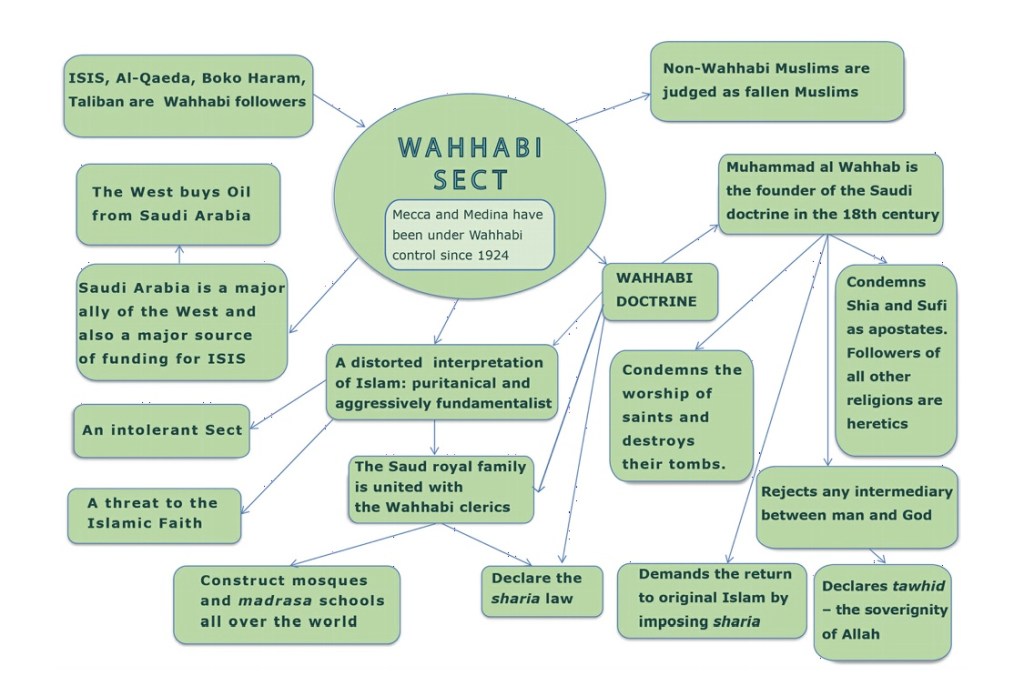
Mind map of the Wahhabi sect, taken from the book

Imagine for a moment, a scenario where a gang of radical thugs living in a desert proceeded to raid the holy cities of Mecca and Medina, kill hundreds of its citizens, eventually destroy 98% of its rich historical sites, and turn the center of Islam from a cosmopolitan and high tolerance society into the epicentrum of their radical views.

Meanwhile, thanks to unbelievable luck they strike the largest oil reserves in the world under their occupied lands, and they get to use the petro-dollar to buy their ways into a massive PR campaign and billions of dollar worth of funding worldwide to spread their radical interpretation as the only true path, ignoring (nay, destroying) the 1400 years of evolution that had previously made Islam as an advanced, sophisticated, and diverse religion. Any competing views get demonised, and any protests are labeled apostasy of Islam since they control the two holy cities (and hence becomes the de facto emperor of Islam).

This, in essence, is Wahhabism in a nutshell.

This book tells the comprehensive history of Wahhabism that began with Muhammad Abdul Wahhab (1703-1792), whom founded the puritanical sect that bears his name. As the author, Terence Ward, says, Wahhab “stressed the absolute sovereignty of God , tawhid or “God’s unity,” and rejected any veneration of saints, holy figures, or even the Prophet Muhammad [PBUH].” With this thinking he began to evangelizes the Arabian Peninsula during the eighteenth century where he calls for a return to the “purity” of the Salaf, the practices of the first generation of Muslims in the year 622.

By contrast, before the Wahhabi revolution Islam had experienced more than a thousand years of evolution that have produced the Golden Age of Islam, with all the scientific discoveries, healthy intellectual debates among different schools of thoughts, equality and prosperity across the Muslim World from Cordoba to Cairo to Baghdad to Damascus to Samarkand. Even the holy city of Mecca, the book remarks, used to be the center of the Sufi universe, “where music, dance, and ecstatic prayer celebrated the divine and faithful gathered at shrines and graves of saints.”

But this were all changed after World War 1. When the great war first broke out British agents encouraged Arab revolts from within the Ottoman Empire (its opponent in the war) including Ibn Saud (1875-1953) whom joint forces with the descendants of Muhammad Abdul Wahhab to conquer the lands in Arabia (historically the insignificant backyard of the Ottoman Empire, before the discovery of oil). An Anglo-Saud friendship treaty was soon signed, and the treaty insisted that Ibn Saud respect Britain’s Gulf protectorates (Qatar, Kuwait, and the Emirates) but it conveniently neglected to mention about the Sharifate of Mecca to the west. Hence, with Britain’s blessing, Ibn Saud and his Wahhabi ally were left free to attack, occupy, and plunder the Holy City.

Mecca and Medina were at the time protected by Sharif Hussein bin Ali, heir of the Hashemite family that had ruled Mecca and Medina for 700 years and 37 generations. And true to the Arab revolt, Sharif Hussein had also allied with Britain and proclaimed the great Arab Revolt against the Ottoman thanks to the persuasion of Lawrence of Arabia.

In return, the British promised him full support for the Arab independence movement, and even offered him the title of “King of the Arabs.” But once the war ended, the British and the French created the Sykes-Picot agreement to divide the Arab lands of Palestine, Iraq, Transjordan, Syria, Lebanon into their own colonial states. Feeling that the Arab cause has been betrayed, Sharif Hussein refused to ratify the treaty.

And thus, by letting the Saud-Wahhabi clan to invade, plunder, and occupy Mecca, Medina and the Hejaz, the British backstab Sharif Hussein once again, and practically chose a more obedient servant to guard the oil wells. Ibn Saud was later awarded a knighthood for his loyalty and service to the British crown, while Sharif Hussein had no choice but to flee into exile and eventually died in Jordan. Some Arabs point to the British support of Ibn Saud (instead of the Hashemite family) as the pivotal act that led to the crisis within Islam now.

After the state of Saudi Arabia was declared, Wahhabism was proclaimed as the official religion, where rigid sharia law is imposed in the kingdom. And in less than 100 years the Saudi-Wahhabi partnership destroyed the countries’ rich and mystic past, including 400-500 historical sites. The Prophet’s (PBUH) house, for example, was destroyed, homes of the Prophet’s wives are now parking lots and public toilet, while the house of the Prophet’s loyal companion Abubakr is now a site of a hotel.

Moreover, in the 1970s thanks to the abundant flood of oil revenues Saudi’s Ministry of Religious Affairs proclaimed Dawa Wahhabiyya (the Wahhabi Mission) and the royal family unleashed charities to fund Wahhabi schools, missionaries, and mosques across the world. Within 3 decades, Ward observed, the Saudis have launched 5 projects to spread Wahhabism:

  1. Pakistan 1977, when General Zia ul-Haq seized power he imposed sharia law and gave freedom in the country to create countless Saudi-funded Wahhabi madrasas across the country to fill the gap of a collapsed education system and indoctrinate young children. They also targeted refugee camps full of Afghans fleeing from the Soviet invasion (this is where the Taliban were born).
  2. Afghanistan 1994, 50 of the indoctrinated Afghan refugees and their leader Mullah Omar launched out offensives to take back Afghanistan, taking Kabul in 1996. By 1997 Saudi employees were travelling there for free as tourists on government-paid holidays with their families, to “witness the true Islam.” In 1998 Mullah Omar was invited on Hajj by the Saudi monarch, and ordered to destroy Bamiyan Buddhas, which they did in March 2001, to comply with Wahhabi’s “no-icon” vision. The free tourism program ended abruptly on 11 September 2001.
  3. Al Qaeda’s global jihad financed by Wahhabi funders, which began in Afghanistan and climaxed with the 9/11 attack. 15 of the 19 hijackers were Saudis, including Osama bin Laden.
  4. ISIS. It began with US invasion on Iraq in 2003. The Shia-majority country was ruled by Sunni Saddam Hussein and his cronies, and after US invasion Shia Nouri Al Maliki became Prime Minister. The Sunni ex-Saddam loyalists were captured and radicalized in the many Iraqi prisons under US watch. And after their release, these loyalists turned into a Saudi-funded fighters against Shia government in Iraq and Shia Assad in Syria. Ward remarks, “when ISIS fighters entered newly captured Syrian towns and Iraqi villages, they burned the old secular schoolbooks. Starting with a clean slate, they gave the shell-shocked students fresh new textbooks, all imported from Saudi Arabia.”
  5. The spread of Wahhabism in the world, with Saudi money and Wahhabi-trained imams installed in Western Europe, from Paris, Brussels, Antwerp, Rotterdam, Marseilles to Birmingham. The Wahhabi mission also operates across the Middle East and North Africa, in Central Asia, Pakistan, Afghanistan, Malaysia, Indonesia (which is comprehensively discussed in chapter 12), and other places in Europe such as Kosovo, Bosnia, Albania. As the book remark, “Support has come from the Saudi government; the royal family; Saudi charities; and Saudi-sponsored organizations including the World Muslim League, the World Assembly of Muslim Youth, and the International Islamic Relief Organization, providing the hardware of impressive edifices and the software of preaching and teaching.” Over the next 4 decades since the 1970s, in non-Muslim-majority countries alone, Saudi Arabia have built 1359 mosques, 210 Islamic centers, 202 universities, and 2000 schools.

Curiously, the final US Senate report on 9/11 attack excluded 28 pages of evidence about Saudi Arabia’s connections to the hijackers. As Ward remarks, “[t]he pages revealed what we have known for a long time: Saudis officials had assisted some hijackers with funds once they came to America. After all, two hijackers had the phone number of the Aspen office of the Saudi ambassador to Washington, Bandar bin Sultan al-Saud.”

Now what could possibly be the explanation for that censorship? The answer remains the same as for the British in the early 20th century as in today: oil. Today, thanks to their massive oil leverage the royal House of Saud plays the dangerous double game of becoming an ally of the West while simultaneously allowing funding into terrorist networks, in which Ward commented “[i]n Palermo, Sicilians pay for “protection” the same way.”

This book is surprisingly short for having such an abundant information (only 136 pages long), but it is very concise and so full of enlightening information that I’ve probably highlighted around 70% of the entire book. And there is no way of covering all the nuggets without over-exceeding the word count for this review. For example, after a thorough introduction of the rise of Wahhabism, it digs deeper into how exactly Wahhabi donations are being made, it links the Wahhabi money to the most unthink of connections such as the Mumbai attack 2008 or Boko Haram or the destruction of the many UNESCO heritage sites in Timbuktu (known as the city of 333 saints from its ancient Sufi tradition), and perhaps the most eye opening one for me is the connection between the House of Saud and Erdoğan in Turkey (which explains a lot of his behaviour and his supporters’ behaviour).

The book is not perfect, however, as I discovered in chapter 8 where the author shows a little too much affection for Ayatollah Khomeini (very respectfully paint him as the brilliant and compassionate leader of the Iranian revolution, while in truth he’s no different than the rigid Wahhabis). Ward also portray Shia as a non-violent followers of Ali, “the true heir of the succession”, while in reality nothing was set in stone and both Sunni and Shia have their fair share of violence. Hence, a small grain of salt is needed to put the objectivity of his views in its right place.

Nevertheless, it is still a very important piece of puzzle to read in order to understand the big picture of global terrorism, the never ending war in the Middle East, the rise of Islamic hardliners around the world, and the dynamics of global politics that come with it. And it is especially useful to learn the many contexts from the book, in order for me to fully understand the recent breaking news that MBS has been proven guilty by the US investigators of killing journalist Jamal Khashoggi in Turkey, but with no further action has been taken so far by both the US and Turkey.

How Goldman Sachs become the most powerful institution in the world

“Money and Power: How Goldman Sachs came to rule the world” by William D. Cohan”

This is a very thorough biography of arguably the most powerful financial institution in the world, Goldman Sachs.

Despite written with the co-operation of the top people at Goldman, it doesn’t censor any wrongdoings and instead it reveals the complete spectrum of the firm from the ugly side of the vampire squid to the absolute masters of the universe, which have mold them into what they are today whether we like it or not.

It reminds me of George Orwell who said “Autobiography is only to be trusted when it reveals something disgraceful. A man who gives a good account of himself is probably lying, since any life when viewed from the inside is simply a series of defeats.” Although this is not an autobiography the logic still applies, and “something disgraceful” are in abundance.

As with any other story of the best of the best, their journey is a very long and treacherous one, from a peddler with a horse-drawn cart to small family business shop selling clothes to sole proprietorship to investment banking novice to growing pains and eventually to the distinguishable master of power and money. And the book captured their story quite magnificently.

It is filled with all the family drama, the infighting with partners, the cheating and backstabbing, the trading scandals, trading successes, the profitless years, the profitable years, the Penn Central fiasco, the sex scandals, civil lawsuits, suicide, succession problems, the high divorce rate, their involvement in propping up financial house of cards of crook Robert Maxwell, the many boardroom battles, the leadership coup, the insider trading cases that look like the episodes of TV series Billions, hostile takeovers, mergers and acquisition wars, the many more deals done by Goldman which often occurred alongside their law firm Sullivan & Cromwell that oftentimes look like the episodes of Suits, and the seemingly minute-by-minute account of the subprime mortgage bubble and crash.

It also filled with the background stories of its larger-than-life characters that are worthy of a TV series, from childhood to the road to Goldman and until their progressive rise from bottom to the very top of the ladder of the company. Characters such as Sidney Weinberg, Gus Levy, Bob Rubin, the two Johns, the new two Johns, Bob Freeman, Steve Friedman, Jon Corzine, Hank Paulson, Lloyd Blankfein – all of whom became a legend in Wall Street -, as well as many other names that became prominent in their own right, such as Christian Siva-Jothy.

The book adds nice little details and plot twists along the way, such as how Goldman Sachs and its arch enemy Lehman Brothers used to be close allies, the sweet story of how Bob Rubin’s parents met, how the men in Gus Levy’s era acted literally like the Wolf of Wall Street, Senior Partner Sydney Weinberg’s role as advisor for presidents (FDR, Truman, Eisenhower, Kennedy, Johnson), the Goldman-Washington revolving door, how the HR office’s telephone never stops ringing during the “amnesty period” for office extramarital affairs, the endurance test of 20 interviews before recruitment, how they train their new recruits, or how close it was for Goldman Sachs to go bankrupt (several times).

While the way Goldman people themselves explained how they do several trades is nothing short of amazing, the book also paints the many scenes at the trading floor including during the Word War 2 and the free for all trading culture in Goldman’s trading room in the 1990s. And for every investment banking or M&A deals, the book analysed them in minute details.

Moreover, in writing the book, the author, William D. Cohan, uses all the best of the best reference, including the famous “Goldman Sachs: The culture of success” by Lisa Endlich when discussing about the Goldman way, “When Genius Failed” by Roger Lowenstein for the LTCM debacle, “The Big Short” by Michael Lewis for the subprime mortgage crash, and even THAT anti-Goldman Rolling Stones article by Matt Taibbi for the Goldman image problem.

All in all, the coverage feels so rich and complete that by the end of the 611 pages book if the author says “and that’s it, that’s everything covered” I’d believe him.

Ultimately, reading this book is like reading war stories and its brilliant tacticians. The morality and humanity of whether or not we should go to war in the first place is out of the question, and instead as the war is already happening the question now becomes who are the best and what strategies are they using? To that end, in the context of corporate America at its most vicious environment of predatory capitalism, Goldman Sachs emerge as the undisputed master of the game and the rulers of the world. Love it, absolutely love it.

Snippets of the wisdom of Peter Drucker

“The Daily Drucker” by Peter F. Drucker

This is the thinking of management guru Peter Drucker summarised into one book. It is great for an introduction but lacking the flows and wider contexts that we would normally get from his books and articles.

The content also do not age that well. For instance, when he is talking about the progress of technology he uses e-mail as the innovative example. He also mentions outsourcing as the increasing trend among organisations, while I forgot how distant early 2000s was when Drucker uses IBM vs Apple as an example for innovation (with IBM as the innovative one and Apple as the loser). This lack of edginess or fresh perspectives are pretty much reflected throughout the book.

This, of course, is probably a bit unfair since Drucker sadly passed away in 2005 and a lot of changes have occurred since then. Nevertheless, this respectfully explains why reading this book sometimes feels like reading an academic textbook back from my business school days.

Philosophy’s greatest hits

“The Philosophy Book: Big ideas simply explained” by Will Buckingham et al

This is philosophy’s greatest hits, featuring all the most influential philosophers throughout the ages. It is a good summary introduction on possibly every big philosophical ideas ever conceived, a good starting point for more deep explorations.

It provides us with the environmental, cultural, and personal contexts in which the ideas came about, and it shows their gradual progressions, cross-influences, and sometimes counter arguments into what becomes a modern thinking that we have now.

The book, however, does not only cover what would be considered as “traditional” philosophers such as Socrates, Voltaire, Spinoza, Nietzsche, or Kierkegaard. But it also includes a broad spectrum of thinkers whose ideas have largely shaped their own respective fields, such as Avicenna (medicine), Machiavelli (politics), Pythagoras (math), Ludwig Wittgenstein (language), Adam Smith (economics), Charles Darwin (science), even Karl Marx (class struggle), among many, many others.

As a recovering Tsundoku-ist (only bought 2 new books this year (so far) to add into my pile of 200+ unread books), I bought this book 10 years ago when the DK Big Ideas series had only just begun with Philosophy and Psychology books. And over the years I only read it scatterly, and never devour it cover to cover like I eventually just did. However, even when reading it randomly the book had already serves me as a some kind of Wikipedia rabbit hole, where it introduces me to some of the big names that I have never heard before (and there are plenty of them in the book) that led me to do follow up readings.

One of the most profound examples is Averroes. When I first read about Averroes in this very book, it prompted me to read several articles and 2 more books about him, one of which opened up my eyes on the incredible Golden Age of Islam, which was very enlightening. This occurred several more times over the years, with the book notably became the first one that also introduced me to Stoicism (I have since read 14 books on Stoicism and live according to its principles).

All in all, it is a fairly light book that breaks down the heaviest ideas into bite-size meditations. It is a treasure trove of a book, a big book, with every sense of the word.

How to teach our kids about money

“The Opposite of Spoiled: Raising kids who are grounded, generous, and smart about money” by Ron Lieber

This book addresses one of the most crucial factors on parenting: how to teach our kids about money.

It covers pretty much everything that you can think of on the subject, including allowance, materialistic trends, peer pressures, how long do we make our kids wait for what they want, how to prevent our kids to become a spoiled brat, down to how much “tooth fairy” should pay for one tooth (which apparently is experiencing a price bubble as we speak).

The book also hit upon the dilemma of loosening the rules at special occasions, on engaging the ego-stand off between parents, on trade offs (such as spending less now in order to have more money later), to teach the kids how to be grateful and humble, how to be compassionate and understanding to the less fortunate, how to behave among the more fortunate, what to do during holidays, and ultimately, addressing on how much is enough?

The format of the book takes life lessons from many case studies, by ordinary parents doing ordinary things just like you and me. Stories that are explained with science and psychology, and include the opinions of child psychologists and personal finance experts, and what they themselves are doing in regards with parenting.

On a personal level, it is a very helpful book for preparing myself for what’s to come in the future, considering I have 2 small kids in elementary school. And while the book is for educating our kids, it is also hugely applicable to us the parents. After all, the author, Ron Lieber, repeatedly state that we’re in the adult-making business, and the lessons in the book are as good as for kids as it is for adults.

Now, if you would excuse me, I’m going to put everything down and play “mute commercial dubbing” with my kids.

The training method that pro runners use

“80/20 Running: Run stronger and race faster by training slower” by Matt Fitzgerald

Over the years, running has become my obsession and I’ve managed to read several books on the subject including Build Your Running Body, few books by RunnersWorld, and a brilliant one by the legendary Hal Higdon. But nothing so far have come close to be as practical as this book.

The first few chapters of the book trace back the various training methods throughout history by enigmatic characters, from Emil Zátopek and Paavo Nurmi, to Arthur Lydiard whom first developed the 80/20 philosophy through 9 years of trial and errors since the late 1940s (and proceeded to became a legendary coach with marathon and Olympic winner disciples), to Stephen Seiler whom codified and scientifically verified the 80/20 method, with several brilliant sports scientists and accomplished athletes in between, including the Kenyans in the early 1960s.

It is fascinating to read about the battle between 2 school of thoughts throughout this timespan: the low-intensity high-volume training vs the speed-based training, in which low-intensity high-volume – which became the basis of 80/20 method – evolved over time to be the method of choice by professional athletes in all endurance sports.

So what is the 80/20 method? The logic is pretty simple: the most crucial key factor to long run (and any endurance sport) is stamina, and we build our stamina through as much training as possible (thus, high volume training). However, higher training volume can expose us to higher risk of injury, and that’s where low intensity training comes into play, to minimise or avoid injuries while we clock in longer training hours. Hence, the 80% effort at low intensity and 20% effort at moderate intensity.

The book then proceeded to make the case for the 80/20 method, presenting the scientific backgrounds for every function and the athletic results that show how the method improves our fitness and skill. It then gets very technical in around halfway through, which, for a running geek such as myself whom loves to dwell into the science, brings out the inner Japanese-schoolgirl in me.

Chapter 7 is the absolute gem of the book, with all the training techniques get to be well-defined and then given the proper example that we can implement instantly, complete with all the heart rate zone analyses. For example, the book lay out the no brainer facts that recovery run is done at zone 1, tempo run is at zone 3, while hill repetition run at zone 5. Although they are seemingly basic, nobody ever mentioned this in the pile of books and hundreds of running articles that I’ve read so far, and it gives me some kind of proper measure to can finally do them right.

The definitions also serve as an explanation of several mix matches that often occur between the techniques, such as what’s the difference between an interval run (zone 3 runs separated by zone 1 recoveries) and speed play (zone 2 runs separated by short bursts of zone 4-5). Moreover, the book does a good job on taking anyone step by step from virtually zero to a progressive journey into a 5K runner (chapter 8), 10K runner (chapter 9), half marathon runner (chapter 10), and full marathon runner (chapter 11), while also discussing at length on the importance of cross training (chapter 12).

All in all, the 80/20 method to the Maffetone method is like Stoicism to philosophy, it is the practical version of slow running method that provides us with the specific tools to properly implement and quantify it. And thus, after finishing the book I can’t help but imagining myself as Margaret Thatcher in that famous cabinet meeting, where she slams down the book Road to Serfdom onto the table and declare “this is what we believe now!”

The big picture on Myanmar’s struggle

“Freedom From Fear” by Aung San Suu Kyi

I bought this book a while ago but never had the priority to read it, then I lost faith in Aung San Suu Kyi in 2017 due to the way she handled the Rohingya crisis, but then 1 February 2021 coup happened. Something doesn’t add up here but I don’t know what, and thus I thought perhaps it’s time to properly read her story, through her own words.

To my surprise, however, unlike most semi-autobiographies the book is not all about her. Instead, it is a thorough history of Burma from the colonial times, to independence, until the current affairs issues as at the time of writing in 1995 (Note that she refers the country as Burma the whole time in the book. While the endonym Burma was derived from the largest ethnic group in the country, the Bama people, the name change to Myanmar – which is politically more correct as it includes the ethnic minorities – was changed in 1989 not long after the military takeover. Hence, the forever association of the name change to military rule).

The first few chapters of the book serve as an excellent introduction to the country Suu Kyi descriptively love and adore, where chapter 2 can easily mistaken for a page from Lonely Planet guide book on Myanmar. Chapter 3-4 cover the story of the struggle for independence and the intellectual elites of historic Burma, while right at the very beginning of the book in chapter 1 Suu Kyi wrote about her national hero father Aung San, whom died when she was just 2 years old and whom never get to see his country’s independence.

The book then proceeded with part 2, with short chapters 5-23 that serve as the core arguments from and for Suu Kyi, some that she wrote herself, few letters to international organizations, several media articles, some transcript to speeches, while there also quite few articles or speeches made by others in honor or on behalf of her. The topics include the psyche of the nation, the social structure of Burma, the political landscape of the country, its dark past present and future, and of course the many arguments for democracy.

Part 3 of the book consist of testimonials on Suu Kyi by several people who knows her personally, and hence gives us the flavour of her real character, which all in all the 3 parts of the book can give us a pretty broad idea about the state of the country and Aung San Suu Kyi as its non-violent “Burmese Gandhi”.

But the future doesn’t look too bright, unfortunately. Here we are 26 years later since the book was written, and most of the names mentioned in the book are still pretty much active in power, or to be more precise, re-surfaced after the coup. And if there is still no real resistance forces from the people (a factor made clear in part 1 of the book as a result of the British colonial ruler), or the lack of leadership in a shape of militant underground like in most struggling countries, there seems to be limited options for the Burmese than to just be submissive to the authoritarian regime once again. But that’s a big if.

Because, while I do not in any way support violence, sometimes it seems that non-violence approach is not working if your opposition is unlike the F. W. de Klerk to Nelson Mandela. Now, for 10 years since 2011 the junta tried to be like Mubarak or Suharto, both of whom “step down” but with backdoor deals that secure their own asses. But as the 2021 coup unfolds, it becomes apparent that the regime could only eventually back down in a Gaddafi way, which, if things remains the same as in the book, is unlikely to happen anytime soon, even 26 years later.

The most exciting book about marketing

“Perennial seller: The art of making and marketing work that lasts” by Ryan Holiday

This is a case for taking it slower and doing it right. To ignore the noise and instead focus on the mastery of our craft. To bidding our time and produce our creative outlet until it is so perfected that it last a long time.

This is also a case of the grueling reality of the producing process and how to handle it properly, and the excitingly bizarre ideas to promote our creations in catchy and effective ways.

And ultimately, this is a case of establishing our platform, developing our network, or in short, building our “1000 true followers.” It’s the difference between building a company and an empire, between a one hit wonder and a perennial seller.

It is by far the most thorough and most exciting book about marketing that I’ve ever read. With the many diverse examples and case studies that are just spot on, which I expect nothing less from a Ryan Holiday book.

In fact, this is like the tell-all book where Ryan Holiday seemingly give away his success formula on his several expertises, from how to be a prolific writer, to how he enduringly handles the producing processes, and how he masterfully conducts the marketing aspects with so many fresh ideas.

In short, it’s a very creativity-provoking book, definitely one not to miss.