David Cameron’s massive own goal

British pound suffer the biggest drop in its history, down to 1985 levels. European shares are bleeding more than -5% while Asian shares are not far behind. Flight to safety made gold rises, European govt bond yield drops (some to negative yields), even bitcoin rises, Swiss franc and Japanese yen surges, and that yen surge crashed the Nikkei in return down to -8%.

All thanks to Brexit. And Brexit is David Cameron’s massive own goal.

In 2013 David Cameron promised to set an EU referendum if his Conservative party wins the 2015 election. At that time migration was not a problem yet for EU and the economy was relatively better, so the call for referendum was his 1st political gamble.

In the 2015 election the Conservative party won, and Cameron pledged to implement the referendum by 2017. This political gamble seems to pay off for Cameron, and by doing so he was attempting to kill 2 birds with 1 stone. The other bird being the Conservative party internal struggle.

Ever since the days of Margaret Thatcher, the Conservatives has been divided between pro-Europe and Euro-sceptics, and the ugly internal rifts have cost the jobs of Margaret Thatcher herself and John Major. Now with David Cameron reigning as the Conservative leader, by pledging the EU referendum by 2017, he will take forward this internal conflict into the national stage.

And then earlier this year in February there was an EU summit negotiating Britain’s membership, and long story short Cameron did not get the terms that he wanted. Straight after the (failed) summit Cameron then finally declared referendum date of 23 June 2016. That’s his 2nd political gamble, to use the referendum as a leverage for negotiating his terms with the EU.

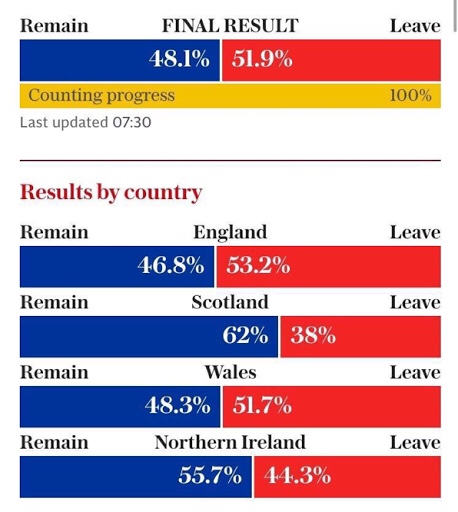
But by now, the migration problem has become a huge crisis for the EU and the economy is practically on life support (negative interest rate and infinite QE by the ECB, among others). And against all betting odds, polling numbers and analysts predictions, Britain voted to leave the EU.

Remember that Cameron, who initiated the referendum, pleaded the public to vote remain. Why would he initiate the exit referendum only to ask the voters to choose stay? Because he thought the public would vote to stay, and that bluffing tactics would give him the advantage to push the terms that he want to the EU.

It’s a massive political own goal, and the world have to endure the consequences (especially the economic costs) and the ripple effects, in which Britain’s exit seems to have opened a pandora’s box where European right wing parties now demand their country’s referendum, Scotland and Northern Island are demanding for their own referendum (since they wish to remain in Europe), while even some folks in Texas are also demanding for a “Texit” referendum.

The high ranking EU officials made it very clear, they are angry that “a whole continent is taken hostage because of an internal fight in the Tory (Conservative) party”, in which the Euro-sceptics led by Boris Johnson won. As a response of his defeat, David Cameron then resigned as the party leader (and effectively as the Prime Minister) and he stated that he will not submit Article 50 to the EU (the official request to start the exit negotiation that will take up to 2 years to complete) before the Conservative elect their new leader in October, which would probably be the Brexit winners Boris Johnson and/or Michael Gove.

In other words, it is as if Cameron is saying to Boris and Gove screw this, you made Britain exit from the EU I’m not going to take care of the exit process. And the lingering of submission of Article 50 to the EU before October will cause a lot of uncertainties in Britain, in EU and in the world markets.

Sexy times ahead.

Update: on 30 June Boris Johnson made a shock announcement that he won’t be running for the Conservative leadership election. The mood of the majority is probably best captured by one tweet by Ewan McGregor who said: “@BorisJohnson You spineless c$&t You lead this ludicrous campaign to leave EU. Win, and now fuc& off to let someone else clear up your mess.”

Further readings:

If [Cameron’s] successor is a Brexit leader, Britain can look forward to being led by someone who has spent the last ten weeks spreading lies [Project Syndicate / Chris Patten]

Recap: 8 of the most misleading promises of the Vote Leave campaign [The Independent / Bethan McKernan]

Some of the most prominent politicians behind the “Leave” campaign are backing away from the false claims and dubious promises that they made in the run-up to the referendum to take Britain out of the European Union [The New York Times / The editorial board]

Strong UK national press bias in favour of Leave revealed by Press Gazette’s Brexitometer front-page tracker [NewStatesman]

The “reverse Greenland”: One solution that could prevent dismantling the United Kingdom after Brexit [Quartz / Aamna Mohdin]

Article 50: Withdrawal of a Member State from the EU [European Parliament]

Brexit in a nutshell

On 20 February 2016, after a prolonged renegotiation at a Summit in Brussels over Britain’s membership to European Union (EU), Prime Minister David Cameron set a referendum date of 23 June 2016 for British people to decide whether to stay in the EU or exit the EU.

The decision for referendum was initially a political promise made by David Cameron in January 2013, where he will conduct an EU referendum by the end of 2017 if the Conservatives are re-elected in 2015, which they were. But some also pointed out that the decision for a referendum was also impulsely made straight after the Summit on Britain’s membership at the EU, in which Cameron did not get all the terms that he wanted and might have decided to use the referendum for leverage.

Nevertheless, for whatever reason, on Thursday 23 June 2016 voters who have registered by 7 June at the latest will begin voting from 7am until 10pm, at 382 local centres across Britain. British, Irish and Commonwealth citizens (from 54 states) who are over 18 and who are resident in the UK are eligible to vote. UK nationals living abroad who have been on the electoral register in the past 15 years are also eligible to vote. In addition, unlike in general election, Commonwealth citizens in Gibraltar are also eligible to vote, as well as citizens of Commonwealth countries Malta and Cyprus.

There are no official exit poll for the referendum, and a lot of the unofficial exit polls are only allowed to start counting the votes simultaneously along with the official vote count, starting from 10pm when the voting closes, up until the morning. The national declaration of the referendum result is then expected to occur “around breakfast time” on Friday 24 June 2016 at Manchester Town Hall, and sometimes during the same day David Cameron will address the nation from Downing Street. Here’s what to watch for as the night unfolds.

When Cameron made the referendum promise back in 2013 the possibility of “Brexit” was slim, but since then the EU had suffered from numerous problems, notably the migration crisis and the economic deteriorations. And these problems have made the chance for both Stay and Exit camps now equally strong. Here are the main arguments for both camps:

If Britain vote to stay, that should be the end of it. But what happens next if the people vote to exit the EU? John Rentoul of The Independent has the best answer:

“If we as a nation vote to leave, that does not mean we cease to be members on 24 June. Constitutionally, the referendum is advisory. It is an instruction to the Government to begin the process of withdrawal.

The Government has various options. It could simply repeal the European Communities Act 1972 and all associated legislation and tell the EU that the UK is no longer a member. That could take a matter of days when Parliament reconvenes on Monday 27 June. But no one expects anything to happen that quickly.

The Lisbon Treaty in 2009 set out for the first time a formal procedure for a country to leave the EU. It would be tactful to use it if we want to remain on good terms with our former partners, and if we want to negotiate favourable terms for our departure. Article 50 sets a time limit of two years on those negotiations, at the end of which Britain would leave.”

Indeed, if Britain exits from the EU there will be uncertainties for few years. And these uncertainties, especially economic uncertainties, have heated up the Brexit debates. The followings are some of the best arguments (both for and against Brexit):

Fact, fiction and Brexit: truth-squadding the arguments [ Bloomberg / Ian Wishart]

5 arguments in favor of a UK Brexit from the EU – and 5 against [MarketWatch / Victor Reklaitis]

Leave or remain in the EU? The arguments for and against Brexit [ The Telegraph / Ben Riley-Smith]

Brexit: Britain flirts with economic insanity [The Washington Post / Robert J. Samuelson]

Brexit risks leaving European banks with $123 billion to cover [Bloomberg / Sally Bakewell and Alastair Marsh]

Brexit’s damage to UK economy would be felt until at least 2020 [The Guardian / Angela Monaghan]

Debunking the Brexit myths [New Statesman / Paul Nurse]

What the first 100 days after Brexit would look like [ZeroHedge]

250 business leaders back exit, say campaigner [BBC News]

What would happened to the NHS if Britain leaves the EU [Sunday Express / Alice Foster]

I am starting to think a Brexit is a good idea and I never thought I would ever say that [Business Insider / Lianna Brinded]

Further readings:

A background guide to Brexit from the European Union [The Economist]

Bloomberg QuickTake: the Brexit debate [Bloomberg QuickTake / Robert Hutton]

The Brexit campaign: a cheat sheet [The Atlantic / Krishnadev Calamur]

What is Brexit and why is there an EU referendum? [The Independent / Oliver Wright and Charlie Cooper]

Nearly all the questions that you can think of are answered in this BBC FAQ, including who are in the Stay camp and who are in Exit camp, and their financial backings [ BBC News / Brian Wheeler and Alex Hunt]

The demographic profile of potential Brexit voters is strikingly similar to that American supporters of Donald Trump and French adherents of the National Front. Opinion polls indicate that British voters back the “Leave”campaign by a wide margin, 65% to 35%, if they did not complete high school, are over 60, or have “D, E” blue-collar occupations. By contrast, university graduates, voters under 40, and members of the “A, B” professional classes plan to vote “Remain” by similar margins of 60% to 40% and higher [Project Syndicate / Anatole Kaletsky]

Something strange emerges when looking behind the “Brexit” bookie odds [ZeroHedge]

What will happen to Britain if there’s Brexit? Here are four possible outcomes [The Independent / Griff Witte]

The deadliest mass shooting in US history

There has been a shooting at a Florida gay night club, the deadliest mass shooting in US history: 50 killed and 53 injured at the last counting. Live updates: [The Guardian]

The shooter use AR-15 rifle. It was used in Sandy Hook massacre and now in Orlando. And the rifle is still legally available for purchase [The Independent / Andrew Buncombe]

In the last week, the shooter was able to legally purchase 2 firearms, a handgun and a long gun, DESPITE already being under FBI scrutiny (he was interviewed by the FBI twice in 2013 and in 2014)

ISIS claims responsibility for the Orlando attack, but gunman’s link to militant group still unclear. And they’re likely to claim anything that can project the illusion that they are powerful [VICE]

Seems likely that the shooter may have pledged allegiance to ISIS, but the attack wasn’t orchestrated by them. Not long ago ISIS spokesman Abu Mohammad al-Adnani said in his Ramadan message to “kill infidels, [and] do it in our name.”

So who was the shooter? His name was Omar Mateen, born in New York, he worked at G4S as a security guard and was described by his ex-wife as abusive (that ended their marriage after only a few months) [The Washington Post / Adam Goldman, Steve Friess and Julie Tate]

Why is this keep on happening? America’s gun problem explained [Vox / German Lopez]

There’s no national database on mass shootings because Congress blocked the CDC from creating one. There’s no way that we can figure out how to stop it if there’s no data to begin with [Vocativ / Joshua A. krisch and Leon Markovitz]

City of Orlando is now listing victims as family is notified [City of Orlando]

My thoughts and prayers are with the victims and their loved ones – Ed

When it comes to violence, Buddhism is no different than other religions

“Buddhist Warfare” by Michael Jerryson and Mark Juergensmeyer

Buddhism is a very diverse religion. It has so many different sects, cultures and leaders that are bind together solely by the teachings of the Buddha. The religion has no unifying canonical scriptures, and each tradition consist of unique set of practices and doctrines that are different from one another, with each version of Buddhism is deeply embeded into the local culture.

This, as an effect, make the subject of Buddhism and its violence a complicated matter and its analysis a monumental challenge. Which is why, perhaps, there are not that many books that cover the subject, and this in return make our basic perception of the religion become distorted by the peaceful image we see on the surface.

This book is the attempt to adress this misconception. It is written with the utmost respect for the religion, not for “exposing the truth” but to understanding the complete picture through reading the scriptures and analysing the impacts throughout history. Its world-class research are conducted by the experts on the field: 11 of the best scholars on the subject, with expert on Buddhism in Japan, Sub Continent, Sri Lanka, Tibet, Mongolia, Korea, China, Thailand and the rest of South East Asia. And the 8 chapters of their findings are a serious body of work that leaves no room for doubts that violence is truly a part of Buddhism, for better and for worse.

First there are the Mongolian Buddhist Khans, whom engaged in acts of violence such as the forceful replacement of Shamanism with Buddhism as state religion, and the implementation of harsh code of conduct to its conquered subjects with torture and death as the punishment. And then there are the many Chinese wars with Buddhist monks participating in the bloodsheds. The brutal cleansing conducted by Buddhists in Sri Lanka. Japanese zen-soldiers and Thai military-monks that blurred the line between state troopers and religious practitioners. And the Korean war where Buddhist monks were at the forefront of the battle against “Imperial America”, complete with its doctrine that demonised the US, a common practice in Buddhist warfare in de-humanising their enemies.

Indeed, a lot of violence are conducted by Buddhists in the name of the state, to first and foremost protect nationalist interest, with few selected scriptures are used to justify the conducts. Verses such as “if a king makes war or torture with compassionate intentions, even those acts can result in the accumulation of vast karmic merit” and “the Buddhist axiom is that everything is suffering… since life is suffering killing one’s neighbour is doing him a favor”, among many others, are often used to justify their violent acts.

If they sound familiar, it is because these kind of scripture-based justifications are also used by the likes of Christian Crusade in their “Holy War”, Jewish extremists in confiscating lands, ethnic cleansing by Hindus in the partition of India and Muslim Jihadists in their terror attacks, and this makes Buddhist violence no different than any other religious violence. In addition, as the first Christian rulers in Europe relied on Christianity to gain support and win their wars, similarly the barbarians in Northern China and in Japan initially adopted Buddhism to gain military advantage in their wars. And while Buddhist extremists are rare, the attack on Tokyo subway in 1995 where Sarin Gas killed a lot of people was conducted by Buddhist militants, in the same manner Al Qaeda launch their offensives.

Moreover, while some wars are conducted to defend a Buddhist community against “enemies” from different faith, there are also a lot of clashes between two or three different schools of Buddhism and traditions. The most eye opener example for me was the sectarian violence that occurred in Tibet during the life of the 5th Dalai Lama, where Tibet was actually divided before violence unite them together in such vicious manner, with the victor’s version of Buddhism eventually became the official religion in Tibet until now.

There are of course a lot more detailed examples written in the book, including the violent acts by Buddhists in everyday life outside the context of war, such as a forced self-mutilation on Chinese monks and the abuse on female Buddhist monks in chauvinistic sects. But this does not redirect our focus from the many majority of Buddhists that indeed live a very tolerant and peaceful life.

Hence, as far as the objective of the book is concern, it is a pretty successful one in describing the complicated world of Buddhist violence without tainting the true religion. And it serves to understand that when it comes to violence all religion are the same, that it’s almost always not about the religion itself but it’s more about power struggle.

A brilliant, out of the box thinking, outside the existing ideologies

“Why Nations Fail: The Origins of Power, Prosperity and Poverty” by Daren Acemoglu and James A. Robinson

What makes a nation successful or a fail state? Not the culture, as proven in the differences between rich Nogales Arizona (US) and poor Nogales Sonora (Mexico) that have the same culture. Not the race, as we can see the miles differences between North Korea and South Korea. Not the religion, where the rich Middle East countries who have oil and the poor ones who don’t have oil they all have the same religion.

It’s not their history either, where China under the same Communist Party was disastrous under Mao Zedong but prosperous under Deng Xiaoping. It’s not the geography, where in the same area Argentina and Chile are relatively prosperous while Bolivia and Peru are relatively poor. And contrary to popular believe, what makes a nation successful or a failure is also not their former colonial power. True that successful US, Singapore, and Australia were former English colonies, but so were Sierra Leone and Nigeria.

No, according to this meticulously researched book, what makes a nation successful or a failure is the institution, and the methods they use to govern their respective nation.

And to that end, the authors have a simple yet powerful hypothesis: there are two types of political power, inclusive and extractive. And likewise there are two types of economic systems, inclusive and extractive. Today’s developed countries are the result of inclusive political institution implementing inclusive economic policies, while failed states are the result of extractive powers implementing extractive economic policies that only enriched its leaders and their cronies at the expense of the people.

And with this simple theory the book takes us to the historical journey around the world, to Brilliantly present their points, and to analyse seemingly every nation in the world from the rise and fall of Roman Empire and Ottoman Empire (extractive in nature), to the rags to riches journey of the US and England (managed to create inclusive institution), down to the smallest tribe political struggles that became the pre-text for what have happened since in present-day Ethiopia and Siera Leone, with one ultimate conclusion: when it comes to wealth of nations and its people nothing is absolute.

Indeed, the southern hemesphere in the American continent – in present-day Peru, Ecuador and Mexico – were once far richer than the present-day US. Baghdad Damascus were once the epicentre of cultures and knowledge while Europe lagged behind. Argentina managed to rise from poverty, to become one of the richest countries in the world, only to collapse back into chaos in the past few decades. So what have made the changing difference for these countries? Central to the authors’ theory are centralisation of political power, critical junctures and creative destruction.

For any nation to function, firstly it need a centralisation of political power. This partly explains why Somalia and Afghanistan are doomed as a failed state because they have no centralised power. It also shows why the centralised Mayan Civilisation were much wealthier than its de-centralised northern neighbours. Conversely, political centralisation could also spell for a disaster, where colonial powers could grab the already existing centralised power to be exploited, such as plantation owners controlling Haiti and Jamaica.

Secondly, any nation would eventually faced with critical junctions, or momentum, whether it was the Black Death in Europe, the Great Revolution in Britain, the French Revolution or the Meiji Restoration in Japan, which ripple effects gave power to a broad coalition of society to create sets of rulers and regulations (such as property rights, universal healthcare) that would benefit the greater masses instead of narrow group of individuals. Or inversely, critical junction could also translated to changing extractive powers from colonial rulers to local powers who would proceeded to exploit the nation in the same manner (or often worse) like in Zimbabwe, Uzbekistan and Democratic Republic of Congo.

Thirdly, for any nation to succeed it needs to undergo a process called creative destruction, i.e. the destruction of inefficient old ways to be replaced by new innovations, such as lightbulbs replacing candles and cars replacing horses, and any other pioneering innovations. For inclusive institutions these changes are welcomed, and became one of the main reasons for economic growth (such as what the steam engine did for the Industrial Revolution in England).

For extractive institutions, however, these creative destructions are supressed by those in power (or their cronies) because it could directly or indirectly destroy or diminish the extractive engine that generate them wealth and power. The building of railways in Astro-Hungarian Empire and Russia are two similar examples, where the availability of railway was feared can create socially dangerous mobility (to be used to organise a rebellion against those in power). And the opposition of abolishment of slaves in the US by Southern plantation owners (whom control the politics at that time) is another example, which lead to the Civil War.

Daren Acemoglu and James Robinson also argues, however, that extractive institution can also generate growth for the nation, in which the growth would then be extracted for their own consumption. This is what happened with the Soviet Union between 1940s to 1980s before the whole thing collapse spectacularly. The authors made a similar remark about the spectacular growth of China since 1980s, where due to the extractive nature of its political power the “Chinese miracle” would soon run out of steam and face reality. This is also why countries like Egypt, Indonesia and Brazil could still have growth in the past under their former dictators.

Specifically for Brazil, the authors gave a very positive outlook on how the Workers’ Party under Lula da Silva can create inclusive political power that gave power to broad sections of the population, which would translated to a brighter future. This, of course, was written in 2012. Since then, especially today in 2016, the “right-wing elites” have staged a political manouvre to topple Lula’s successor Dilma Rousseff and replaced her and her entire cabinet with unelected crooks (almost all of them have impending corruption charges), which will likely bring Brazil back to extractive regime. This echoes with what had happened in the fall of the great maritime power of Venice, which the book brilliantly analysed.

This is by far the best book to read to really understand politics, power play and the huge role economic institution play in the political arena. It is an out-of-the-box thinking outside the battle of economic ideologies, with findings perfectly summarised the situation for each one of the countries mentioned in the book, and with tools that can easily be implemented in analysing those countries that aren’t mentioned in the book.

If I somehow could get the chance to meet my president and I’m allowed to give 1 book to him, it would be this one.

It’s not religion that causes violence, it’s power struggle

“Fields of Blood: Religion and the History of Violence” by Karen Armstrong

Karen Armstrong should not need another introduction. She left behind her life as a Roman Catholic nun to devote a lifetime studying world religion, and she becomes one of the greatest religious scholars that has ever lived in the process. She is now, in her own words, a “freelance monotheist”, and it is reflected in her careful, respectful and unbiased way of writting on every different religion. This book is another testament on this deep care and her range of knowledge on the subject matter.

Fields of Blood seemingly discusses every single violence conducted in the name of religion, from ancient societies like the Summerians, the Assyrians, the Egyptians, the Greeks, Zoroastrians, Confucian, to the Abraham religion and the many religions in the Sub Continent, to the era of first secular states (the US and post-revolution France), until the rise of Zionism, the current “war on terror” era and the most recent rise of ISIS. Within this scope, she masterfully narrated on the politics, the struggles and the social interactions in each one of those eras, and explains us the gradual and intricate evolution of religion from the time religion, state and daily lives have not been separated yet, into the religion as we know it today.

The book is so full of information and so airtight, however, that it can sometimes feel a little too complicated and unecessarily detailed. But I believe it is not meant to be memorised but rather to give us the big picture of how massively complex religious evolution is. And as always, Ms Armstrong focused on the historical facts rather than the mystics or the folklores, and thus some may find the revelation in the book unsettling, such as the degree of editing the Bible experienced, or how Islamic Hadits were conveniently tailored, or the mysterious discovery of questionable scrolls containing the teachings of Moses for the Jews, despite the fact that during Moses’ time in 8th century BC teachings were taught verbally rather than in writting – all of which have 1 underlying purpose: to match the rulers’ political needs at the time. And this is the central thesis of the book.

The slaughter of American Indians and Bosnians in the name of religion, the Holy War in medieval Europe, the deadly clashes between Hindus and Muslims in India, the violent acts by the likes of the Crusaders, the Conquistadors and the jihadists, in fact all violence that are conducted in the name of religion are all man made. And the scripture-based justification that comes with them are nothing short of a political doctrine, not much different than the atheist doctrines by Hitler, Stalin and Mao.

As Karen Armstrong herself puts it “terrorism is fundamentally and inherently political, even when other motives—religious, economic, or social—are involved. Terrorism is always about “power—acquiring it or keeping it.” And so, according to one of the pioneering experts in the field, “all terrorist organizations, whether their long-term political aim is revolution, national self-determination, preservation or restoration of the status quo, or reform, are engaged in a struggle for political power with a government they wish to influence and replace.””

Indeed, our main focus when it comes to religious violence should not be the religion, but what have happened in that specific occurance that created violence in the name of religion. And to that end, learning from this book, there seems to be a pattern where all root causes of violence eventually come from these 5 stages:

1. There are groups of people that are treated unfairly or even opressed. Whether it is a religious minority, different sect controlled by other establishment, economic inequality, a whole area controlled by foreign occupation, or orthodox religious community opressed by secularism and modernity.

2. A leader emerged out of them to fight for these people, to bring justice, to give them voice and to guide them out of their misery, where the leader at first advocates non-violent measures to address the issues.

3. Only to be crushed, slaughtered and tortured by those in power, which pushed them to the edge and force them to be radical. Karen Armstrong commented on this matter by saying that “fear of annihilation and the experience of state violence often radicalize a religious tradition.”

4. And so, in response, these leaders then declare a Holy War / Jihad (struggle) / martyrdom as a desperate attempt to fight the iron fist establishment, and portraying violence as “the only option” left for them. They began to justify violence by quoting their holy book and fit the opressors into their doctrine (i.e. Fit the description of jahaliyah, or the devil, etc).

5. Their end goal may varies but one thing is certain, whatever the objective is it has little (if any) to do with the actual religion but a lot to do with power struggle.

Karen Armstrong then elaborate, “the claim that the primary motivation of a terrorist action is political may seem obvious—but not to those who seem determined to regard such atrocious acts of violence as merely “senseless.” Many of that view, not surprisingly, find religion, which they regard as a byword for irrationality, to be the ultimate cause.”

Questioning which religion is more violent than the other is, therefore, completely missing the point, a reality that Karen Armstrong addressed when she commented on Richard Dawkin’s view on religion as “dangerous oversimplification [that] springs from a misunderstanding of both religion and terrorism.” She did admit that “this, of course, is not to deny that religion has often been implicated in terrorist atrocities…” But nevertheless, “it is far too easy to make it a scapegoat rather than trying to see what is really going on in the world.”

There are thousands more words that can be written in this review, with thousands specific examples can be derived from this book. It is indeed the hardest review I’ve written so far, simply because there are so many great things about the book, and so many important points that I want to cover but could not possibly fit them all in just one short review. It is definitely one of my top 10 books to read to understand how the world really works. It is trully a masterpiece.

Context: Why the Panama Papers is such a big deal

The Panama Papers is the biggest data leak in history. It is 2.6 TB worth of data, consisted of 11.5 million documents leaked from a Panamanian law firm Mossack Fonseca that cover 38 years from 1977 to 2015. As many as 214,488 business entities and 14,153 intermediaries are apparently involved, connecting 202 countries, 12 country leaders (both current and former), 61 relatives and associates of country leaders, 128 politicians and public officials (both current and former), including 29 of Forbes-listed billionaires.

The data were leaked by an anonymous source to a German newspaper Süddeutsche Zeitung, and were investigated by more than 400 reporters for over a year by a huge coordination by International Consortium of Investigative Journalists, Süddeutsche Zeitung and more than 100 other news organizations. And as we can read all over the global news the results of the investigation are astounding, although they are not really that surprising.

According to an expert on tax heaven Nicholas Shaxson, the offshore system that tore financial control apart since the 1970s has served as an accelerator for flight of capital, as well as a distorting field that altered capital flows not to where they necessarily find the most productive investment, but rather lured to where they can provide the most lenient regulations, accommodate evasion of prudential banking regulations, offer zero or lenient taxes, grant freedom from rules of civilised society and where they can provide the greatest secrecy. Hence, money becomes increasingly out of reach for those who need funding and investment to build a better future, and instead the majority of those who have money prefer to hide their money where nobody can touch them.

Today there are more than 80 tax havens around the world, including the Caribbean havens, Luxembourg, Lichtenstein, Cyprus, Andorra, Switzerland, Singapore, Hong Kong and indeed Panama; and the number of listed offshore subsidiaries in them are staggering. For instance, the British Virgin Islands (with population of 25,000 people) hosts approximately 460,000 corporations, one modest building in the Cayman Islands host more than 18,000 entities, while the tiny South Pacific island of Nauru (with population less than 10,000 people and have only 1 road) host 400 banks and provide laundering services for billions of dollars of Russian money.

In other words, the leaks from one law firm in Panama that we are currently digesting are most probably just the very tip of the iceberg. But the tip of the iceberg might just be sufficient enough to shed a light on the secretive world of offshore economy, and could be used to tackle some of the biggest problems in the world right now that are connected to tax havens.

Because on paper more than half of world trade now passes through these tax havens, with a third of foreign direct investments by multinational corporations are channeled through the offshore routes. Moreover, over half of all banking assets also routed through offshore, with around 85% of international banking and bond issuance take place in Euromarket, a stateless offshore zone. In 2008 the Tax Justice network discovered that 99 out of 100 Europe’s largest corporations use offshore subsidiaries, with a bank as the largest users in each country. Meanwhile in a December report of the same year, the US Government Accountability Office (GAO) reveals that 83 of US’ largest 100 corporations had subsidiaries in tax havens, including the big banks that receive bail-out money.

The intentions are clear, thanks to tax havens many of the world’s largest and profitable corporations pay no or little tax, making these corporations more profitable by the years, at the expense of depleted government funding for the development of the country and the wellfare of its citizens. For example, according to US-bases Citizens for Tax Justice from 2006 to 2011 General Electric’s net federal income taxes have been negative $2.7 billion, despite the fact that they gained $39.2 billion in pre-tax US profit over the same period. Google was able to cut its tax rate by more than $3 billion through a technique called the “Dutch Sandwich,” where the company channel its profits through Ireland, the Netherlands and then to Bermuda. Also thanks to tax haven network, in 2010 the likes of Bank of America, Exxon/Mobil, Boeing and Citicorp paid no federal taxes.

To be fair, by law the number 1 objective for any publicly-traded corporation is to maximise shareholders’ wealth, and this includes seeking the best possible tax arrangements in order to maximise profit. Hence, tax avoidance is not necessarily a bad thing, and it is even legal (tax evasion, on the other hand, is illegal). However, legal tax avoidance is one thing, but it is a completely different matter if bribing is involved. A March 2012 investigation revealed exactly this, where 30 large US corporations that paid no federal income tax between 2008 and 2010 were also major contributors to US politicians in both parties, specifically to the committee members that control tax policy in both Chambers of Congress. But even this form of bribing is still technically legal, as it is protected by the First Amendment, and more crucially because the rules and regulations are made by among themselves, thanks to the revolving-door policy.

The usage of tax havens are finally considered illegal when they play a role in illegal activities such as the existence of insider trading ring, gigantic frauds and the growth of complex monopolies in certain markets. With this regards, almost every big financial catastrophe – from the collapse of Long Term Capital Management to Lehman Brothers to AIG and Enron – are illegal tax haven stories. In the case of Enron, before being exposed as a fraud the company had more than 6,500 shell companies in several tax havens, 600 of which were registered in the Cayman Island, that were used to artificially jack up their stock price, before the whole cornering scam collapsed spectacularly.

All in all, in 2010 the IMF estimated that the balance sheets of small island tax havens alone added up to $18 trillion, a sum equivalent to around a third of the world’s GDP, and that, it said, was probably an underestimate. Therefore, as we can see, tax havens and the offshore transactions have become a big problem for the world economy, although some of their transactions are still technically legal. But remember, what Hitler did in Germany were also legal, but it doesn’t mean that they were right.

By the end of 2010, according to James S. Henry, a former chief economist at the consultancy firm McKinsey in his report The Price of Offshore Revisited, the global super-rich elite has at least $21-32 trillion of financial wealth hidden in tax havens, or equivalent to the size of the US and Japanese economies combined. Henry’s report was commissioned by UK’s Tax Justice Network, and it used the data from the Bank of International Settlements, International Monetary Fund, World Bank and national governments to highlight the impact on the balance sheets of 139 developing countries that have its citizens’ money held in tax havens (financial wealth only, not including assets such as property, racehorse, goldbricks and yachts) and thus out of reach from their local tax authorities.

In the report, Henry discovered that since the 1970s, with aggressive and often illegal assistance from the international private banking industry, around $7.3 to 9.3 trillion of unrecorded offshore wealth have been accumulated by private elites by 2010 in this sub-group of 139 countries, even when their country were flushed in debts and enduring Structural Adjustment Program. When looking at the 50 leading private banks alone, they already collectively managed more than $12.1 trillion for their clients in cross-border investing, with the top 3 private banks in handling the most assets offshore are Goldman Sachs, UBS and Credit Suisse. Henry then commented that “The lost tax revenues implied by our estimates is huge. It is large enough to make a significant difference to the finances of many countries, [and it creates] a huge black hole in the world economy.”

On this scale of the black hole, the offshore economy is large enough to significantly alter the estimates of national income and debt ratios, estimates of inequality of income and wealth, and above all, the negative impacts on the domestic tax bases of key source countries (countries that project net unrecorded private capital outflow over time). A case in point, in 2010 these same developing countries had aggregate gross external debt of $4.08 trillion, and were categorised as debtors. But when the debts are subtracted with their foreign reserves (most of which are invested in developed countries’ securities such as US Treasury bills) their aggregate net external debts were actually minus $2.8 trillion. This has been increasing steadily since 1998 when these 139 countries’ external debt minus foreign reserves was at their peak at plus $1.43 trillion.

In other words, by way of the offshore system, these supposedly debtors countries are not debtors at all, instead they are actually net lenders to the tune of $10.1 to 13.1 trillion. The problem, however, is that the assets of these developing countries are held by a small group of wealthy individuals, with the the majority of the assets ended up stored in tax havens, while the debts of the countries are shouldered by the ordinary citizens through their governments, where the debts normally imposed under dreadful conditions and interests. Henry then elaborates that “these private unrecorded offshore assets and the public debts are intimately linked, historically speaking: the dramatic increase in unrecorded capital outflows (and the private demand for First World currency and other assets) in the 1970s and 1980s was positively correlated with a surge in First World loans to developing countries: much of this borrowing left these countries under the table within months, and even weeks, of being disbursed.”

David Graeber illustrates this point in his book Debt: the first 5000 years, where after the Petrodollar Recycling in the 1970s and 1980s Western banks suddenly flushed with OPEC profit money from the oil crisis, and these banks began to send agents around the world trying to convince Third World dictators and politicians to take out dollar-denominated loans from them. A surge of First World loans to developing countries then occurred, a lot of which were to African countries, with corrupt dictators borrowed a lot of money with national assets as the collateral (often persuaded by the bankers themselves), with the majority of the borrowed money would end up being directly transferred to their offshore bank account (i.e. unrecorded capital outflows) and created a black hole in the country’s economy.

But then, when the dictators were toppled or simply replaced by a honest regime, these offshore bank accounts remain untouched while the country (more specifically, the people) have to bear the burden of the debt repayment + interests that they never use, or worse, forced to surrender their control over the country’s economic sovereignty or loose their national assets for plundering. And thus the countries forever remain poor, stuck in a vicious cycle of debt refinancings and plunders.

And this is where the Panama Papers can make a big difference. As the 11.5 million documents are revealed one by one, one day at a time, we are gradually learning what the database of names are doing with their offshore accounts, whether it is perfectly legal or shaddy like what have been revealed in details on day 1 about Vladimir Putin and the prime minister of Iceland.

Although right now it is still a huge mountain to climb, the specific information that the leaks provide could become the shed of evidence, and perhaps the leverage, needed to finally start the serious discussions for a global regulation on tax havens. Because not only they facilitate tax avoidance transactions, tax havens also facilitate illegal financial transactions, fund the smugglings of drugs and weapons, fund human trafficking, fund wars and sectarian violences, and become the harbour of corrupt money that has created a huge black hole in the world economy – all of which are the root-causes of the world’s main problems.

Note: a big chunk of my arguments here are excerpts from my bigger-picture argument piece on the current state of world economy.

Further readings:

Panama Papers: the secrets of dirty money [Süddeutsche Zeitung]

What you need to know about the Panama Papers [The Guardian / Luke Harding]

This is also a good explanation on Mossack Fonseca, the Panama Papers and the offshore system in general [Vox / Matthew Yglesias]

Panama Papers leaker: “I want to make these crimes public” [The Daily Beast / Nico Hines]

How reporters pulled off the Panama Papers, the biggest leak in whistleblower history [Wired / Andy Greenberg]

Victims of offshore [The International Consortium of Investigative Journalists]

Here’s the price countries pay for tax evasion exposed in Panama Papers [The Intercept / Jon Schwarz]

Panama Papers: why some of this is perfectly legal [Al Jazeera English / Abid Ali]

The power players (interactive) [The International Consortium of Investigative Journalists]

The political fallout from the Panama Papers [The Atlantic / Krishnadev Calamur]

Mossack Fonseca’s response [Miami Herald / Sohail Al-Jamea and Ali Rizvi-McClatchy]

Five myths about tax haven [The Washington Post / Nicholas Shaxson]

FAQs on Tax Havens [Tax Justice Network]

Panama is only one head of the tax haven hydra [The Financial Times / Nicholas Shaxson]

The geography of financial secrecy: what the Panama Papers don’t reveal may be more important than what they do [The Atlantic / Uri Friedman]

Everyone are freaking out about the Panama Papers, but the biggest fallout is yet to come [Mother Jones / Kevin Drum]

Act now. Don’t wait for another crisis [The Guardian / Thomas Piketty]

Road to reform: How the UK government has the power to make its tax havens stop enabling crime and corruption [Global Witness / Robert Palmer and Oliver Courtney]

How politicians could stop offshore tax havens (if they wanted to) [VICE / David Dayen]

9 May 2016: Panama Papers database goes online, giving details to the wider public of 200,000 offshore accounts [International Consortium of Investigative Journalism]

Successful people have winning habits, and this book analyses them well

“Power Habits: 101 Life Lessons & Success Habits of Great Leaders, Business Icons and Inspirational Achievers” by Chris Luke

They say don’t judge a book by it’s cover, but for this book what you see on the cover is pretty much what you get. The book has 101 chapters, one for each successful individual and their most powerful habit. It has the curiosity of Albert Einstein, the focus of Anthony Robbins, the time efficiency of Henry Ford, the visualisation of Ronaldinho, all the way to the reason why James Bond take cold showers.

The book analyses what makes the likes of Bill Gates, Steve Jobs, Elon Musk and Richard Branson successful, but it also discusses the winning formula for South Park writers, Oprah Winfrey, Bruce Lee, Kobe Bryant, and fictional characters such as Jason Bourne and fight club’s Tyler Durden. Moreover, between the successful people and their amazing stories there are the inspiring Lao Tzu, Aristotle, Socrates, Mahatma Gandhi, Nelson Mandela and Dalai Lama. While every once in a while you’ll get pleasantly surprised by the individual that pops up in the next chapter, like Kanye West.

Yes, the book is serious, inspiring, and fun at the same time. It’s a bite size read with each chapter consists of only 2-3 pages, which makes it easy to digest. Furthermore, the 101 chapters are categorised into 9 sections (life habits, success habits, motivational habits, rich habits, productive habits, creative habits, fit and healthy habits, social habits, and minimalistic habits), and they are all written in such a concise way that the entire book looks like a long note consisting only the important things.

One habit that stuck with me throughout was the fact that almost every successful people – from JFK to Warren Buffett to Mark Zuckerberg – read a lot of books, with the author himself keep on referring to some of the best books to make his points across. Another common habit that stuck in my head is how efficient and simplified they actually are (especially Benjamin Franklin and Leonardo Da Vinci), and how systematic they are (especially Winston Churchill and Ernest Hemingway).

I didn’t really like the rich habits section, however, as it sounds too Robert Kiyosaki-centrist cult of get rich with passive income cliché, while seemingly undermining any other professions (while in reality successful professional “employees” like lawyers and investment bankers can make way more money than entrepreneurs making passive income from an amateurish startup – it’s all relative. And many vocational callings cannot even be measured by money, like teachers, scientists and doctors). And that explains the 4 stars. But to be fair, in retrospect, the get rich habits section may be very useful for twenty-something who are just starting out in the real world (hence, I’d give 4 1/2 stars if only Amazon still have it).

All in all, it is an entertaining book, easy to read, but yet very resourceful at the same time. I’m going to take more stairs than lifts from now on, will try Salvador Dali’s method of power nap, will slowly targeting myself to be able to read like Tai Lopez, will organise my mornings like Howard Schultz, will keep practising my craft until it’s perfect like The Beatles, and will do it all with the confidence of Muhammad Ali.

The scientific explanation for mind vs heart situations

“The Chimp Paradox: The Acclaimed Mind Management Programme to Help You Achieve Success, Confidence and Happiness” by Steve Peters

There are two phrases, among others, that I like to live by. The first is “if you don’t like something change it, if you can’t change it change your attitude towards it.” And the second one is “you can’t control how you feel, but you can control how you react to it.” These two phrases have Chimp Paradox written all over it, and this book is pretty much the great elaboration of the phrases.

Derive his fact-based theories from neurological researches and decades of experience, Prof Steve Peters analyses the mechanism of the brain between the Frontal (the logical Human), the Limbic (the emotional Chimp) and Parietal (the memory-storing Computer), and how different functions of these 3 can conflict and/or complement each others to produce our thinking process and decision making process.

Surprisingly, for such a complex subject matter this book is really a light reading, which is written in a simple and concise way using easy to digest symbols, diagrams and bullet points. But yet, when I tried to read more on neuobiology as a follow up, I can somehow keep up with the complicated and serious stuff thanks to the understanding from this book.

It is by far the book that I highlighted the most, with every single line seems to be important, and it is so psychologically spot on that it feels like it is tailored on the conflicts between my own Human and Chimp. It also gives me huge understanding on how to differentiate between the Human and the Chimp in people around me (and how to engage to them accordingly), and it even has given me a clear and simple solutions to some of my, my family’s, and friends’ real problems. 5 stars!

Trump: The rise of evil?

Donald Trump re-tweeted Italian dictator Mussolini’s quote and refused to condemn former KKK leader who backed him. Anne Frank’s step sister and two former Mexican presidents all said that he reminds them of Hitler, while French Neo-Nazi Jean-Marie Le Pen, Dutch’s prominent nut job Geert Wilders and some other European Far Rights not surprisingly are endorsing him.

Meanwhile, former CIA director said that if Trump is elected president the military might not obey him (and implying of a possible coup), Wall Street and the markets are already spooked by him, and even the GOP itself is having an internal conflict over the possibility of him becoming their front runner.

He’s racist, he’s sexist, and he provokes religious hatred. He’s even a Lannister. But yet Donald Trump is still winning the Republican primaries. How on earth can he pull such a stunt? One possible explanation for this is what’s written in this hoax meme, which makes perfect sense considering that Trump is currently leading thanks to only blurted out chants and meaningless rants in his campaign speeches instead of clearly describing his actual policies. Another possibility is that there are simply a lot more white supremacists in the US than previously thought. Or maybe, just maybe, he really is a great presidential candidate and all of the Trump critics somehow get it wrong?

One thing is for sure, although he’s technically not a fascist he’s a pretty damn close one, at least during this presidential campaign. And we all know what happened with 1930s Europe under fascism. Be careful what you wish for, America.

Further readings:

The Trump Doctrine: end NATO, patrol Mosques, nukes for Japan & allies [Informed Comment / Juan Cole]

After a long time, Donald Trump finally unveils his foreign policy plan. And it’s ugly [The Guardian / Dan Roberts]

Campaign finance documents show Donald Trump’s campaign is in disarray [Mother Jones / Russ Choma]

What’s in Trump’s returns? A look at how he plays tax game [Yahoo Finance / Nancy Benac]

A lot of the money the Trump campaign has spent is going directly back to Donald Trump [Vox / Libby Nelson]

Warren Buffett nailed why Donald Trump’s businesses failed in a lecture 25 years ago [Yahoo Finance / Julia La Roche]

The sales strategies of Trump University find echoes in its namesake’s presidential campaign [The Atlantic / Matt Ford]

For future reference on Trump pro-gun policy: Owner of company that makes AR-15s to attend Donald Trump fundraiser [The Huffington Post / Ben Walsh]

Trump on climate change: Trump’s stupidity has crossed the line towards dangerous for the fate of the planet [Reuters / Emily Flitter and Steve Holland]

More than 400 writers sign petition protesting Donald Trump [The New York Times / Alan Rappeport]

Meet Frank Amedia: Trump’s Christian policy adviser believes he single-handedly stopped a tsunami and healed cancer [Mother Jones / Hannah Levintova]