On praying for Aleppo

Another failed truce on Syria between proxies Russia and US has made headlines all over the media, and has sparked the public outcry on the civilians trapped in Aleppo. Indeed the inhuman conditions they are experiencing are unacceptable, let’s pray for Aleppo and donate however we can. But please don’t forget about the other Syrian cities also devastated by the war.

Pray for Madaya, where people are starving to death right in front of international NGO’s eyes, in which they can’t do anything about because there’s no safe access for the humanitarian convoys. Also pray for people in the likes of Homs, Kobane and Idlib province, whose homes are also flattened to the ground. Pray for people in Raqqa and in border towns near Turkey, who have experienced hell on earth under ISIS occupation. Pray for those Syrians managed to get out from the country, but have to accept the harsh reality as an unwanted refugee in Europe.

While we’re still talking about the region, please pray for the opressed native in an Apartheid state which I dare not say its sensitive name. And please pray for Yemen, which has been suffering from multiple airstrikes by Saudi Arabia and experiencing ongoing destructions as severe as in Syria. Up to 10,000 people have died in Yemen, and according to a UNICEF report nearly 90% of its population (around 21 million people) are in need of humanitarian assistance, where 14 million of them lacked sufficient food and more than 320,000 children under 5 are at risk of extreme malnutrition.

Now if you’re serious about donating, please make sure that the organisation you’re donating to have a very clear method to deliver your donation to its intended recipient. Because in order for any of the NGOs to do something in a particular area, they have to gain permission from whomever control that area at the time (Assad / Kurds / ISIS / one of the many rebel armies), and the controllers keep on changing. And due to the constant fire exchanges among them, a lot of access to that area are blocked.

I’m not going to give any link or recommendation for the NGOs because I’m no better. I sent a humanitarian donation to Syria in 2011 at the start of Arab Spring, for “the people” of Syria who were under attack by the Assad government. As we all know, some of “the people” then broke into many little rebel armies who fight against Assad, fight against ISIS, and even fight against each others, with no report of any humanitarian aid ever sufficiently recorded. Hence, my donation can easily be used for military equipments and thus becoming a part of the problem.

But still, some humanitarian aid do go through, and do help the civilians a lot, we just have to find the right brave men and women that have the best channels on the ground.

We as a private citizen can only do so much, but we can also contribute to pressuring the proxies that have the real power to stop all of this chaos – the US, the Russians and the UN. Pressure them to form a long-lasting peace agreement, via human rights NGOs like Amnesty International, Human Rights Watch, Avaaz, etc. But remember to pressure both sides not just one, because in Syrian conflict there are no heroes, just complicated vested interests in both sides with civilians trapped in the middle.

The men who bring out humanity from the dark ages

“The Clockwork Universe: Isaac Newton, the Royal Society, and the birth of the modern world” by Edward Dolnick

There was a time when London was a filthy town, a smelly feces-ridden place filled with people who thought the Great Fire of 1666 was God’s wrath. It was a time when the majority of the population in Europe were dying fast due to the Plague, when medicine was still experimental and even worsening the conditions, when life expectancy was ridiculously low. It was a time when freaky autopsies on rabbits, dogs and even dead fetuses were conducted, while prosecuting and torturing criminals were the highly anticipated public attractions. Curiosity was a sin, and proof-testing God’s creation was almost considered as an insult to our Creator.

In the middle of this chaos exist a group of men who think differently. Who think that God is a mathematician, and the universe operates in precise mathematical codes and moves like a clockwork. These men conducted experiments, made many breakthroughs in human knowledge, and challenged the bleak perception of the world they used to live in. This group of men was called the Royal Society, and one of their superstar members was Isaac Newton.

This book is the history of science, an incredible story of several brilliant minds “cracking the codes” that God has created masterfully. It is the evolution of scientific knowledge from the times of Aristotle, Copernicus, Pascal, Kepler, and Galileo, which have paved the theoretical background for the brilliant story of our protagonist Isaac Newton.

It is the story of the long struggle to proof, for instance, that the world is round, that it is spinning on its own axis and it is rotating the sun. About how the planets in our solar system were discovered. It is about the origins of many mathematical tools, such as how Descartes came to create the X and Y graph we frequently use today. And it is also about the true account of the discoveries, instead of the myth, of the famous eureka moments like Newton’s apple tree and Archimedes’ bath that was actually untrue.

The theoretical debates were intense, the rivalries were bitter, the struggles were human, and the failed experiments even the public reactions were all narrated into an intriguing story of origins for every physics laws. Ultimately, this book is the journey about how humanity came out from the dark ages, and how these gifted men sparked the beginning of the modern world that evolves around scientific discoveries, which last till this day.

Fidel Castro

Since the 1950s, in Latin America socialist revolutionaries often become the overcompensating remedy for CIA-backed dictators like Fulgencio Batista. Fidel Castro is one of them.

Just like in Orwell’s Animal Farm, many of the socialist leaders ended up becoming brutal dictators themselves, but they’re not the antagonists in a clear line between good and evil. For every action there is an equal and opposite reaction, Castro is merely the response to what Naomi Klein refer as the “Shock Doctrine”, which have created open veins in the region.

Rest in peace, or rot in hell, Fidel Castro. Whatever.

Hillary won the popular votes

Just in case u missed it: HILLARY WON THE POPULAR VOTE

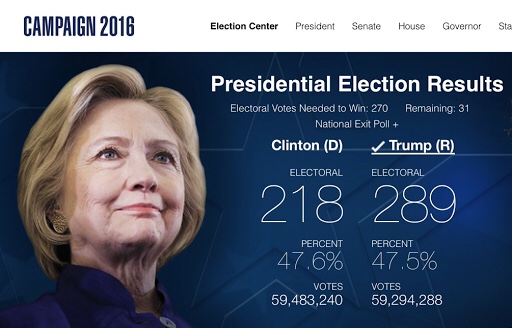
Hillary 59,483,240 votes

Trump 59,294,288 votes

The “people” elected Hillary

But “the system” elected Trump

How did that happen? The answer: The electoral college.

Americans did cast their votes for a new president, but the electoral college eventually made the final decision: 538 electoral voters represent 50 states and District of Columbia. And the candidates need 270 votes to win.

Trump won because he got 289 electoral college votes, even though Hillary won almost 200,000 more popular votes than Trump.

In the 2000 US presidential election, Al Gore also received 543,000 more votes than his rival George W Bush. But Bush was still declared the winner because Bush won the electoral college votes.

That’s why there were riots when Bush became president, and that’s why there are riots in many cities now in the US. Their vote do not matter.

Democracy? What democracy?

Further readings:

The troubling reason the electoral college exist [Time / Akhil Reed Amar]

The Rakai Pikatans of Indonesian history

“A brief history of Indonesia: Sultans, Spices and Tsunamis: the incredible story of South East Asia’s largest nation” by Tim Hannigan

There once lived a man named Rakai Pikatan. He was the man who puts an end to the mighty Sailendra dynasty in Java, and in the year 856 he ordered his men to build a temple that match Sailendra’s masterpiece, the Borobudur. The temple has since been known as the Prambanan.

Few centuries later in 1357, Majapahit’s king Hayam Wuruk appeared to attempt to forge an alliance with the Pajajaran kingdom in West Java, by promising to marry princess Pitaloka, the daughter of the Pajajaran king. But when the Pajajaran wedding party arrived in Majapahit’s capital, prime minister Gajah Mada informed them that the princess would merely becomes a concubine and that they should surrender to their East Java overlord. Surrounded by hostile Majapahit forces, the Pajajaran men bravely refused and put up a fight, but they were all eventually slaughtered, including the princess.

Meanwhile, by the mid 15th century the spread of Islam had reached as far east as the eastern islands in the archipelago. With so many Muslim chiefs rulling so many tiny islands at the time, Arab spice traders began to call the area Jazirat al-Muluk (the islands of kings) – a name that eventually became Maluku.

Moreover, in 1811 the archipelago almost had its independence from the colonial Dutch. Following Napoleon’s attack on the Netherlands, the British decided to consficate and disband Napoleon Dutch’s colonial grab in the East Indies. The British originally gave the order to British governor-general in Calcutta, Lord Minto, to “overwhelm the Dutch forces, destroy their fortifications, dish out their guns and ammunition to the locals, and hand the island over to the Javanese.” But what prevent the independence was one act of disobedience by Lord Minto. He dismantled the Dutch forces within a few weeks, but then installed Raffles as his lieutenant-governor in the archipelago with free rein to rule the colony as he pleased. And the rest, as they say, is history.

History is messy, brutal, and oftentimes blurry. For many centuries to come the temples of Prambanan were buried and the locals only know the folktale version of its history – where a man built a thousand temples overnight as a condition to marry princess Roro Jonggrang – and they do not even know who Rakai Pikatan is.

Students of history in Indonesia would also likely to learn Majapahit as the peaceful empire that unite the whole archipelago. While in reality, they obtain the majority of their territories by force and in some instances even only claim them without ever setting foot on the land. And just like Srivijaya before them, Majapahit was more of a powerful kingdom claiming control to a small population of traders and port cities beyond their stronghold capital, rather than an empire.

And these misconceptions of history sums up how historical accounts are being perceived in Indonesia.

This book is about the Rakai Pikatans of Indonesian history, and not the Roro Jonggrangs. About the likes of kingdom of Majapahit (not the empire) and its day to day struggles and ugly realities. It is about the intriguing origins of many historic names, the lost opportunities and the very human decision made by the likes of Lord Minto that changed the course of history. It is in short an attempt to straightening up the facts of Indonesia’s past.

The book is also about the forgotten truth. About the equally important role Sutan Sjahrir played beside Soekarno and Hatta in the independence movement for Indonesia. About Budi Utomo that began as an organisation to lobby for more education for Indonesia’s elite class in a Dutch-controlled government, and not an anti-colonial revolutionary organisation as they usually perceived. It is about how the Japanese was sympathetic with Indonesian independence movement and was actually administering towards an independence for Java in September 1945 (with the rest of Indonesia follow suit shortly), before Hiroshima and Nagasaki were bombed a month before that and Indonesian revolutionaries had to take matters into their own hands for independence.

Perhaps the best feature of the book is how Tim Hannigan can bring the complex stories of Indonesia’s past into a gripping narrative. The book indeed reads like an epic novel, and it filled with deliciously detailed accounts that constantly intrigue as we read on, such as how the country’s motto Bhinneka Tunggal Ika is a fragment of a 14th century poem celebrating the unity of Shiva and Buddha, or the story of how 4 ways conflict made Jakarta the capital city of the Dutch colony, or the fact that Zheng He’s magnificent fleets that came to the archipelago were commanded by 7 eunuchs.

But most of all, it is a book that explains every sequences that lead to many different realities in Indonesia today. For instance, contrary to popular believe, the Dutch were actually respectful to the local royal kingdoms during their occupation, they even forged useful alliances with some of them that mutually benefit everyone. And it was exactly these alliances that caused these kingdoms’ eventual demise, with the simple fact that since almost all of them were allies with the Dutch they resisted the national independence cause that was centered in Jakarta, that is, apart from Yogyakarta. Which is why after the independence only Yogyakarta’s sultanate survived and go down in Indonesian history as one of the heroes.

All in all, it is a well-crafted and very well-researched book, written in a careful ways so that the facts, the speculations and the myths are clearly distinguished. It is the most complete historical account on Indonesia that I have read so far, and it is the number one book I would recommend to anyone who wants to know about Indonesia.

Just be a decent human being

Ada video Buni Yani mengakui kalo dia salah karena udah edit video Ahok yang di pulau 1000, dan tulis caption yang provokatif diluar context yang akhirnya memicu amarah.

Dan ada article yang bilang Buni Yani juga udah beberapa kali memelintir perkataan ulama-ulama terkenal lain nya, seperti kata-kata Quraish Shihab yang dipelintir sehingga seolah-olah beliau bilang Nabi tidak dijamin masuk surga karena amal atau perbuatannya.

Ada juga video Ahok di interview di Berita Satu, yang menjelaskan tentang insiden “penistaan agama” tersebut dari sisi dia.

Nggak sedikit juga beredar article dan foto-foto forward-an yang menunjukkan bahwa aksi demo kemarin emang benar damai, dan yang baru rusuh setelah jam 6 malem itu bukan karena mereka.

Dan hari ini juga mulai banyak foto-foto, broadcast messages dan articles di media yang secara spesifik membahas gelagat aneh satu politisi baper, dan strongly implying kalo dia “aktor politik” yang disebut sama Jokowi kemarin.

Gua pingin posting semua itu satu per satu, tapi akhirnya nggak jadi abis nyadar this one ugly truth: people only see what they want to see.

Yang nggak suka sama ormas-ormas kemarin nggak bakal percaya kalo mereka bisa jalani demo damai. Yang judging kalo Islam itu brutal dan barbaric bakal nggak percaya kalo yang bikin rusuh itu dalang politik, bukan agama.

Yang nggak suka sama Ahok juga nggak bakal mau abisin waktu cuma 5 menit untuk nonton penjelasan dia. Yang nelen mentah-mentah editan propaganda nya Buni Yani nggak bakal terima kalo dia ternyata salah. Dan yang genuinely percaya kalo demo ini tentang agama dan nggak ada unsur politik dibaliknya, nggak bakal berubah pikiran kalo dikasih banyak bukti politisasi.

Churchill once said “a fanatic is one who can’t change his mind and won’t change the subject”, while psychologist Leon Festinger said “a man with a conviction is a hard man to change. Tell him you disagree and he turns away. Show him facts or figures and he questions your sources. Appeal to logic and he fails to see your point.”

So why bother posting hal-hal yang supporter udah bakal langsung setuju dan oposisi bakal langsung bilang itu sampah? We have better things to do than arguing sama temen dan keluarga, over something yang kita nggak punya direct influence anyway other than voting di Pilkada nanti.

So please chill, tranquillo. It doesn’t really matter who you support and what you believe in, just be a decent human being. The next 2 weeks won’t be easy for us, and we all need to stick together.

Kemerdekaan Nusantara 1811

Did u know? Nusantara hampir merdeka dari penjajahan Belanda pada tahun 1811, waktu French Revolution nya Napoleon Bonaparte nyebar sampai ke Belanda.

Pada saat Belanda lagi diserang abis-abisan oleh Perancis, Inggris memutuskan untuk merebut koloni-koloni Belanda di Nusantara. Untuk eksekusi rencana ini, Inggris memberi tugas perebutan tersebut ke governor-general Inggris di Calcutta, Lord Minto, dengan rencana awal untuk melumpuhkan para pasukan Belanda, menghancurkan senjata persediaan dan pertahanan mereka, dan mengembalikan Nusantara ke penduduk lokal (sultan, raja, dll).

Akan tetapi Lord Minto nggak mematuhi perintah pusat, dan setelah berhasil melumpuhkan Belanda Lord Minto memasang Thomas Stamford Raffles sebagai leutenant-governor (atau wakil nya Minto) di Nusantara, dan Raffles diberi kekuasaan penuh untuk lakuin apapun yang dia mau.

Kalo Nusantara merdeka tahun 1811 mungkin kita masih terpecah-pecah sampai sekarang, mungkin antar kerajaan masih berantem dan asimilasi antar suku dan budaya nggak pernah kejadian (alias banyak dari kita yang nggak bakal lahir). Kalo Nusantara merdeka tahun 1811 Sumpah Pemuda 1928 mungkin nggak kejadian dan Soekarno mungkin nggak pernah menyatukan seluruh Nusantara menjadi negara Indonesia. Funny how one act of disobedience can change the entire history of a nation. And here we are now.

Dirgahayu RI ke 71!

Erdoğan’s coup

And so we’re finally here, an attempted military coup during Erdoğan’s peak madness. Fasten your seatbelt, coz it’s going to be a really bumpy road ahead for Turkey.

Note that Turkish military coups occurred in 1960, 1971, 1980, 1993, and 1997. So just like in Thailand, Pakistan and many Latin American countries, it’s sadly a bit like business as usual. But this time around on 15 July 2016, it’s not a question of if, but when. “Sultan” Erdoğan had it coming.

Guest writer Michael Rubin sums it all up nicely in ZeroHedge few months ago:

“Could there be a coup in Turkey? The situation in Turkey is bad and getting worse. It’s not just the deterioration in security amidst a wave of terrorism. Public debt might be stable, but private debt is out-of-control, the tourism sector is in free-fall, and the decline in the currency has impacted every citizen’s buying power. There is a broad sense, election results notwithstanding, that President Recep Tayyip Erdogan is out-of-control. He is imprisoning opponents, seizing newspapers left and right, and building palaces at the rate of a mad sultan or aspiring caliph. In recent weeks, he has once again threatened to dissolve the constitutional court. Corruption is rife. His son Bilal reportedly fled Italy on a forged Saudi diplomatic passport as the Italian police closed in on him in an alleged money laundering scandal. His outbursts are raising eyebrows both in Turkey and abroad. Even members of his ruling party whisper about his increasing paranoia which, according to some Turkish officials, has gotten so bad that he seeks to install anti-aircraft missiles at his palace to prevent airborne men-in-black from targeting him in a snatch-and-grab operation.”

But hang on a minute. Wild speculation spread among Turkish people on the streets that the coup was actually masterminded by Erdoğan himself, to justify the drastic actions that he would make next. And sure enough, after declaring that the coup attempt has failed, Erdoğan dismissed 2,745 judges and prosecutors, and arrested nearly 3000 military personnel. He also said that the coup justifies further consolidation of power, while providing questionable evidence on thousands of perpetrators that were miraculously collected in less than 24 hours.

The EU commissioner dealing with Turkey’s membership bid, Johannes Hahn, even suggested that “the swift rounding of judges and others after a failed coup in Turkey indicated the government had prepared a list beforehand.”

Meanwhile, the coup is officially blamed on Fethullah Gülen, which according to Dylan Matthews in his brilliant explanation on the Gülen Movement, “it’s very possible that Erdoğan would target Gülen even if he played no role in the events.” The allegation is of course denied by Gülen, where he said “the uprising by members of the country’s military could have been “staged” by the government”, echoing the speculation on the streets.

Regardless whether the speculation about Erdoğan’s mastermind is right or wrong, in the end he really did take advantage of this attempted coup and create himself a stronger counter-coup to obtain more power than ever, something that Vladimir Putin would’ve been proud of.

Some European leaders have already expressed their concern over the scale of Erdoğan’s purges, which seems to escalate by the day and nowhere near to be stopped: just 72 hours after the attempted coup, 103 generals and admirals in total have been detained, while 7,899 police officers, 614 gendarmerie officers, 30 provincial governors and 47 district governors have all been suspended. Even the finance ministry has suspended 1500 employees. As arguably the last obstacle for Erdoğan to become an absolute ruler, the Turkish parliament is the only institution left standing. And as we speak, it is under a total lockdown due to an imminent security threat.

And so it appears that we’ve actually seen nothing yet, and the crazy ride with Erdoğan is only just beginning.

Post-72-hours updates:

• The purge continues to education (get ready for a massive propaganda): The government revoked the licenses of 21,000 people working in private schools, fired 15,000 people working in the education ministry and demanded the resignation of 1,577 deans.

• 20 news websites are blocked.

• 492 people from Religious Affairs Directorate, 399 from Ministry of Family and Social Policies, 257 from the prime minister’s office, and 100 intelligence officers are all sacked.

• 20 July: Erdoğan invoked “emergency powers” under the constitution, which will last for 3 months. This allow Erdoğan and his cabinet to enact laws without the approval of parliament. God knows what kind of laws they’re going to change (presumably, a lot). And 1 day later he told Reuters “No obstacle to extending Turkey’s state of emergency beyond initial three months.”

• 21 July: From the Associated Press: “Turkey deputy prime minister says his country to suspend European human rights convention under new state of emergency.”

• 23 July: Erdoğan shuts down 1000+ private schools, 1200+ charity organisations, and 15 universities.

• 26 July: Turkish government ordered the closure of over 130 media outlets (3 news agencies, 23 radio stations, 16 TV channels, 45 newspapers, 15 magazines and 29 publishers and distributors). The government also dismissed 1684 military personnel, including 149 generals and admirals (“amounting to nearly half of the high-ranking officers in the entire Turkish military” as Reuters reported). In return, 99 colonels have been promoted to the rank of general and admiral.

• 31 July: The government has cancelled the passport of around 50,000 people, to prevent them leaving the country. And Erdoğan give himself and his [puppet] prime minister the power to issue direct orders to military commanders.

• 2 August: Turkey’s football authorities have fired 94 people, which include referees, assistant referees, regional refereeing committee members and national and regional observers.

• 3 August: Now it’s actors’ turn, they are suspended from City Theaters.

• 12 August: the government issued an arrest warrant for Turkish football legend Hakan Sukur.

• 16 August: Turkish police raids 44 companies and had warrants to detain 120 executives, over their suspected links to the failed coup.

• 17 August: justice minister Bekir Bozdag said that they “will grant early release to some 38,000 prisoners who committed crimes before July 1”, to free space for alledged coup plotters.

Further readings:

Turkey’s ideological debate [Bloomberg QuickTake / Onur Ant and Caroline Alexander]

Sultan Erdogan: Turkey’s rebranding into the new, old Ottoman Empire [The Atlantic / Cinar Kiper]

The madness of Turkey’s “sultan” Erdogan [The Daily Beast / Maajid Nawaz]

Emperor Erdogan: why an increasingly authoritarian Turkey poses a danger to the region [Politico / Steven A. Cook]

Turkey’s baffling coup [Project Syndicate / Dani Rodrik]

Was Turkey’s coup attempt just an elaborate hoax by Erdogan? [Al Monitor / Cengiz Çandar]

Very good lessons in business, from unusual trades around the world

“The Adventure Capitalist: Camels, Carpets and Coffee: how face-to-face trade is the new economics” by Conor Woodman

Conor Woodman left his job at the City of London, sold his flat, put all of his belongings in a storage, and converted his £25,000 profit from selling his flat into $50,000 (the GBP/USD rate at the time). He then use the money to invest and trade while circum-navigating the world, with one objective: to find out whether we can still trade the old way: to buy something in one country, travel with it, and sell it in another country.

His trade routes and its commodities were quite unusual, which make the book interesting: Selling carpet in Morrocco, camel trading in Sudan, selling Zambian coffee in South Africa, selling South African chilli sauce in India, horse trading in Kyrgyzstan, buying jade in Kashgar, selling Taiwanese oolong tea in Japan, selling Mexican tequila in Brazil, and more.

This in not your typical round-the-world adventure book, however, this is not even a backpacking story. Instead, this is a trained economist doing real business trade with real professional businessmen in their respective fields, making long term business connections in the process between the buyers and the selers that he has helped to establish.

Indeed, to my (pleasant) surprise, the entire book has the feel of a business book. It’s the economics of pricing, the art of negotiation and salesmanship, the power of branding, the importance of contracts and licensing, the ancient business tricks by different cultures, how to extract the real market price from traders, the highs and lows of exporting and going through customs, and how to recover when your plan A doesn’t work out and you really need to get rid of the commodities before leaping to another quest.

But of course, since this is a round-the-world trip to mostly unusual places and meeting unusual people, the high-and-low tales of adventures were (thankfully) not lost: horse racing in Uzbekistan border, getting slammed by Mexican waves, stranded in a Sudanese desert, fishing race in Japan with a wager to marry the fisherman’s daughter if he lost, to name a few, and of course the thrills of negotiations and risk takings.

All in all, I began reading this book with the expectation of a light reading on amusing adventure tale. But instead, I got so much more from it: the adventure story, the local insights and the very good lessons in business. And just in case you were wondering, yes, this is the same Conor Woodman that would eventually host the brilliant National Geographic show “Scam City.”

A vital book to read to understand Islam in Indonesia

“Understanding Islam in Indonesia: Politics and Diversity” by Robert Pringle

There was a time when Nahdlatul Ulama (NU) was a political party in Indonesia, when Muslim Communists exist and did not contridict itself, and when the 1st Pancasila was in 5th and declared “Believe in God, with the obligation of the adherent of Islam to carry out Islamic law” (Ketuhanan, dengan kewajiban menjalankan syari’at Islam bagi pemuluk-pemuluk nya).

Furthermore, there are good explanations why in the whole Sumatra island only the Toba Batak people are Christian majority, why the people in Bali remain Hindu, and why those in eastern parts of Indonesia are predominantly Roman Catholics and Protestants. Meanwhile, there is a cheeky urban myth on why the Istiqlal national mosque has 12 pillars, created by its Christian architech. And contrary to popular believe that Muhammadiyah organisation is named after the Prophet Muhammad (PBUH), the organisation was actually named after their theological godfather Muhammad ‘Abduh, a 19th century Egyptian reformer.

Moreover, did you know that the “Wali Songo” whom spread Islam in Java were mostly Chinese and Vietnamese descents? And did you know that Imam Bonjol in Padri War was in truth a Wahhabi mob that attacked the Minangkabau matrilineal tradition (they even killed some members of the Minangkabau royal family) and wanted to make Minangkabau an extreme-syariah state? The Minang indigenous requested help to the Dutch, and because he fought the Dutch in a war this Imam from Bonjol became a national hero and not a radical fundamentalist in Indonesia’s history book.

As the title suggest this book is indeed about Islam in Indonesia. But it is not about the theological history of Islam in Indonesia, although the author covered this in quite some length as well. Instead, it is first and foremost the history of politics in Indonesia – from the Hindu-Buddhist kingdoms era, to colonial subject under the Dutch English and Japanese occupations, into the formation of the independent state of Indonesia, the turbulant first few decades, the post-1965 violence, until the modern Indonesia as we know it today – with Islam plays one of the most central roles in every era and influenced the evolution of the country. And conversely, this book is also the history of religion in Indonesia with Islam emerged as the dominant power that are shaped by the political scenes.

Central to the evolution of Islam in Indonesia (and thus the development of the book) are two great mainstream Muslim organisations, Nahdlatul Ulama (which the author refer as Traditionalist, due to its assimilation with the traditional local cultures) and Muhammadiyah (which the author refer as Reformist due to its more doctrinaire style). And both organisations act as the pillar of Islam in Indonesia, which covers social, educational (with its great network of boarding schools (pesantren)), political and professional aspects of daily lives.

There are also those Islamic militant groups that became “the other side” of Islam evolution in Indonesia, such as separatist Darul Islam and Al-Qaeda-affiliated Jemaah Islamiyah whom wanted to make Indonesia an extreme-syariah compliant nation. There are also the organised political parties such as Masyumi and PKS that have tried (but so far fail) to make Islam a more dominant force in Indonesian politics. And then there is Majelis Ulama Indonesia (MUI), an organisation that was originally created in 1975 to mobilise support for Suharto’s development policies, to give them stamp of approval from a religiously progressive minority of clerics, but then has since issued some of the most controversial (and idiotic) fatwas after the fall of Suharto.

All of the big events throughout the country’s history, all of the big names, the many riots and violences in the name of religion in Poso, Ambon, Aceh, Dayak vs Madura, etc are analysed. All of the structure and history of Islamic organisations are also discussed in details in the book, from every single political parties, separatist groups, down to the vast Islamic school system – from the 14000 pesantren in Java, to Surau in West Sumatra and Dayah in Aceh.

The author himself is an ex American diplomat who had served in Indonesia, and it was only natural of me to be sceptical at the author at first, where quite often a book by an American diplomat resident are written through the bias of the American point of view and its Foreign Policy interests. But to my delight, Robert Pringle remain balanced and unbiased throughout, where he did not hold back on the raw truths, did not sugar-coat the reality of American involvements in some of the deadly occurrences in Indonesian history, and he also acknowledged some of the rumours without filter.

I especially like the brilliant conclusion at the very end, where the author writes with a touching respect and love towards Indonesia, describing the complicated web of events that have created the unique and moderate Islam that Indonesia now have, and he ultimately concluded that Indonesia’s own diversity “act as a break, however imperfect, on ideological, religious or political extremism.” Lazy cover aside, this book could not do any better than this. 5 stars!