Lessons from an unfair world

“The Trial” by Franz Kafka

Franz Kafka lived a tragic and boring life. And he died without ever knowing that his writings would become one of the most impactful in the world of literature, just like Van Gough never get to see his masterpieces be really appreciated in his time.

Kafka was born in 1883, in Prague, Austro-Hungarian Empire. He had a lonely childhood filled with sickness, endured a difficult relationship with his overbearing and totalitarian father, and worked at a dull job as a clerical staff of the Workers’ Accident Insurance Institute – all of which contributed to his bleak worldview – before he got admitted to a sanatorium near Vienna where he died of laryngeal tuberculosis in 1924 aged just 40.

Before he passed away, on his death bed he instructed his friend Max Brod to burn all of his unpublished works that include a series of notes, letters, drafts, drawings, and some failed published works, all of which he wrote every late night after coming home from work. But luckily for us Brod did not do as instructed, but instead he edited them, polished them, and eventually published them. And thus we are able to read the masterpieces today, which has since been translated to more than 65 languages and has sold over 25 million copies worldwide.

You know that sentence, when the student is ready the teacher will appear? Sometimes I feel like some books suddenly appear when I’m ready for it, or in a real need of it. And this book is one of those books. Today, after all what I’ve experienced and witnessed, I increasingly see the world as an unjust place where the assholes can get away with their crimes, where not all felony will be caught and prosecuted, where karma doesn’t seem to exist, and that plenty of stories don’t have a happy ending.

And this bleak reality is illustrated clearly in this book, the Trial, a novel written in 1914-1915 and published posthumously in 1925.

In this book, the protagonist Josef K is being arrested without any warrant, where his possessions are subject for seizure by the state, his privacy being invaded, and he is facing a trial over something that has never been revealed both to him and to the reader, nor who the accusers are.

Instead, the reason of the arrest is never clear and the manner of his arrest is also strange, where he can still roam free in the city and do his job, but he is obliged to attend the trials at weird places with crowds that have irregular behaviour. And wherever he goes, whether in public or in the trials, observing eyes always follow his movements, which makes him feel more imprisoned than being locked up in a physical prison.

Moreover, under this bizarre circumstance, Josef then tries to mercifully clear his name, but quickly find out that the law is nothing but a broken maze of bureaucracy that is full of contradictions and have no real way out. In the effort, he meets all sorts of different people, each with their own shadiness, which only added to Josef’s confusion and paranoia.

And spoiler alert, the book suddenly ends with the weirdest execution of Josef, where not even a court sentence is announced but instead 2 men pick him up and escort him to a quarry outside the city where he then get stabbed to death.

The abrupt ending heightened the sense of hopelessness and just the sheer absurdity of the unfair trial and execution, and it leaves so many questions unanswered, including who was that person behind the window observing Josef’s stabbing? It is indeed nightmarish and illogical, a common theme in Kafka’s writings that have since dubbed as “Kafkaesque.”

But don’t despair just yet. The strength of the book is not necessarily in the story itself, but instead it is in the lessons from the journey. Such as how Josef responds calmly to the unclear accusation and unfair treatment, how he subtly trying to gather as much information as possible from the shady characters he encounters, and how he still keeps his dignity and sanity throughout this trying period.

The story also teaches us about learning to accept reality as it is. That sometimes there’s no ending or closure, or things will never be fully resolved or even understood. It also teaches us to accept our limits within this reality, in order to be more content and comfortable with our lives. Accepting our limits also means learning to accept imperfection and teaches us to be more compassionate and understanding towards ourselves and indeed towards others, like Josef did in many occasions. And it is only after we have accepted our limits that we can then focus on our strengths and use them to our advantage.

Another lesson is to make the most out of our situation, even though we’re in a very difficult circumstance (such as in Josef’s situation of isolation and alienation), and to still find resilience although our circumstance looks hopeless. But perhaps above all, the story teaches us a lesson about courage, that Josef didn’t run away from his problems by leaving the city (as suggested by his uncle), but he face the indignant treatments with head held up high.

I can’t believe that I can learn quite a lot from a dark and pessimistic story, with lessons over traits that are useful to have so that we can deal better with the cruel real world. I guess that is what makes Kafka a maestro.

The tale of modern China through the story of its mastermind

“Deng Xiaoping and the Transformation of China” by Ezra F. Vogel

This is a very ambitious book, written by an author who knows China and its elites very well from his time as an intelligence officer in East Asia for the Clinton administration. The book tells the complete story of China’s incredible transformation in the late 20th century, from poverty and famine to the economic superpower they are today. It is a tale told from the vantage point of the transformation’s chief architect, the pragmatic and disciplined Deng Xiaoping.

Through a painstakingly diligent research, that includes interviews with Deng’s interpreters, the book traces Deng’s story from his time in Paris as a student in the early 1920s, his move in joining the Chinese Revolution from the ground up after coming home in 1927, to facing Mao’s cult of personality, political exile, and a turbulent return and rise to power in 50 years that include several heartbreaks, betrayals, even death.

It then focused on the main era that defines both Deng and China, the period of time when he eventually became China’s leader from 1878 to 1989 and then in 1992. During this time he managed to loosen the economic and social policies that had stunted China’s growth, modernized the country with technology and science, as well as opening the trade relationship with the West. All of which lifted hundreds of millions of Chinese out of poverty.

But these things are never easy, are they? This is where the book excels, it show’s Deng’s expert maneuvers within the politics of the country as well as his diplomatic prowess at the international stage, with the details of the conversations and conflicts behind the scene are all laid out in the pages. It is quite a story, worthy of all the 745 pages of the book.

No wonder that it has won multiple awards, including: Economist Best Book of the Year, Financial Times Book of the year, Bloomberg News Book of the Year, Wall Street Journal Book of the year, Washington Post Book of the Year, Esquire China Book of the year, Gates Notes Top Read of the Year, Finalist for National Book Critics Circle Awards, and Winner of the Lionel Gelber Prize.

A short history of Nakba

How the state of Israel was created

Have you ever wondered why the flags of the Arab countries all look similar?

Image by Mapsome

It was World War 1 (1914-1918), with over 30 countries divided into 2 sides: the Allied powers with the likes of Britain, France, Russia, Italy, Serbia and the United States. And Central Powers that consist of Germany, Austria-Hungary, Bulgaria and the Ottoman Empire. One of Allied’s war tactics was to destroy the Ottoman from the inside, by funding a revolution in its Arab provinces (a role romanticised by Lawrence of Arabia, a British spy). And they were all organised under 1 flag, the Arab Revolt flag.

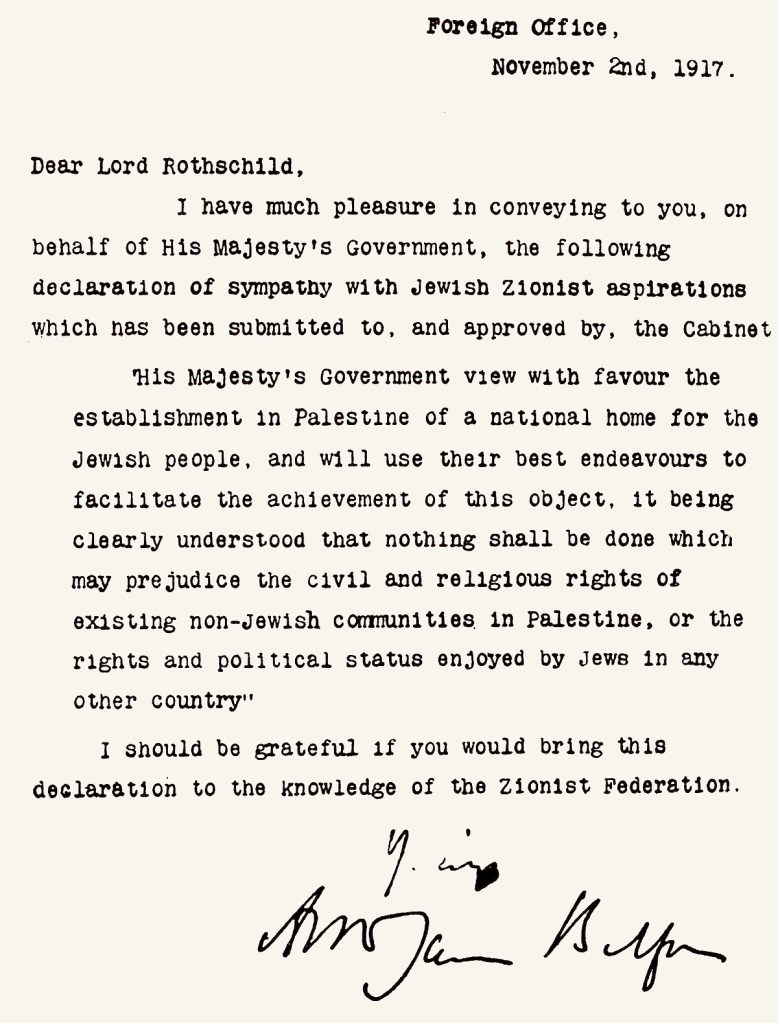
Another Allied tactic was to gather war support from the Jewish community in Britain, in exchange for the realisation of the Zionist aspiration to establish a Jewish national home in Palestine:

Image by Wikipedia

This has since dubbed as the Balfour Declaration 1917.

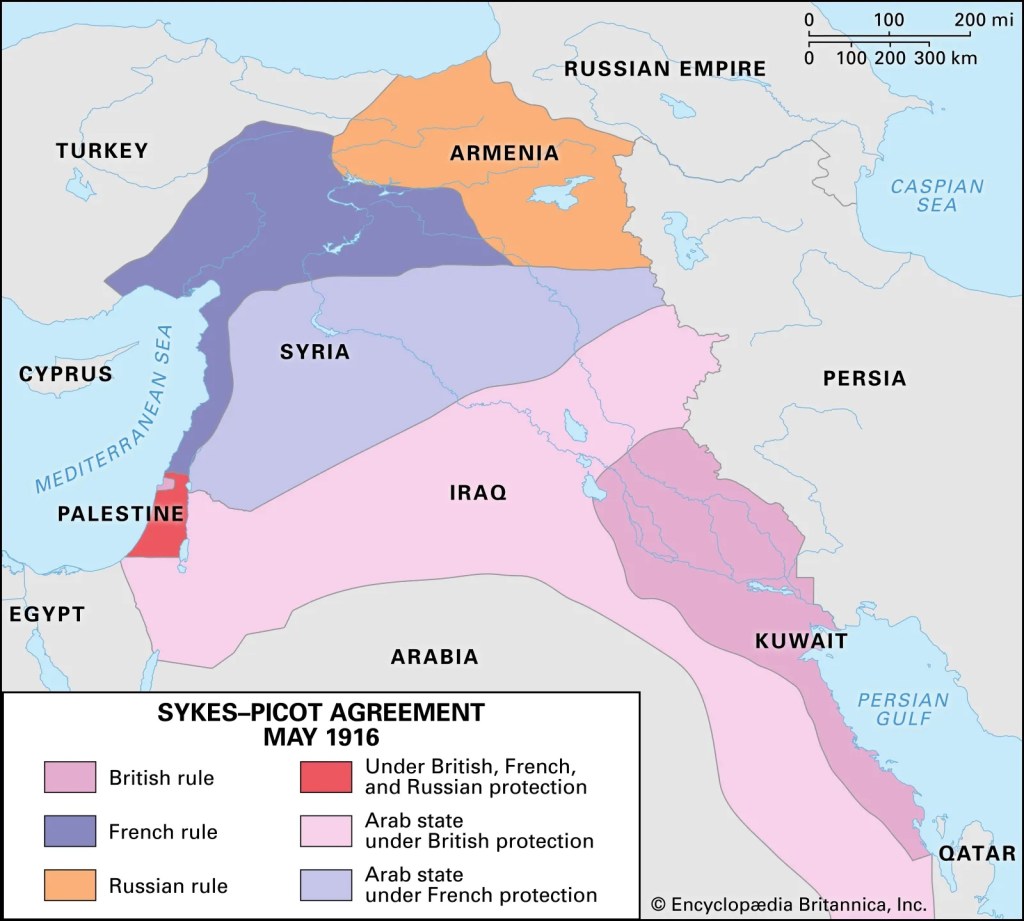
In the midst of the war, between November 1915 – March 1916, British diplomat Mark Sykes and French diplomat Francois Picot negotiated on behalf of their respective countries, and resulted with the Sykes-Picot Agreement 1916 that drew the map of the Middle East into British-rule, French-rule and Russia-rule. Before they even won the war. The initial plan looked like this:

Image by Encyclopaedia Britannica

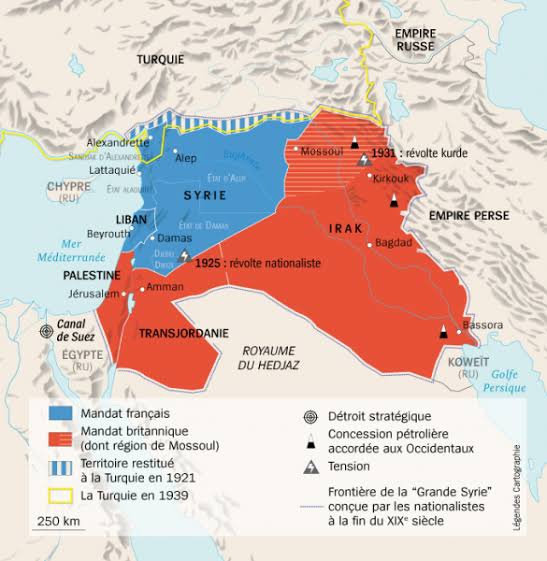
But then a lot of things happened during the war, including the Russian Revolution and the Turkish War of Independence, which changed the balance of power and the distribution of land prizes when the war was over (and the Ottoman Empire being dismantled). Another agreement was needed, and so the Conference of San Remo took place in 1920. Which gave the blue area to France, and the red area to Britain (including Palestine).

Image by L’Histoire

Prior to this, World War 1 was formally ended in a truce but the majority of the war reparation was imposed upon Germany which was formalised in article 231 of the Treaty of Versailles 1919. The payment of this reparation was done through recklessly printing money, which would debase their currency and eventually cause hyperinflation in the next few decades in Germany.

Meanwhile, following the Conference of San Remo, the British mandate of Palestine was formalised in 1920 by the League of Nations (the precursor of the United Nations) in a special article in its legislations. And the person that Britain put in Palestine as its first high commissioner? A British Jewish Zionist by the name of Herbert Samuel.

Moreover, the economic woes in Germany got worse after the Great Depression in the 1930s where hundred of thousands became unemployed and starving. People needed a saviour from this hellhole and a reason for their misery, and Adolf Hitler provided both. In his bid for power, Hitler use speeches that scapegoated the Jews – or more specifically the “international Jewish bankers” who were present in the Treaty of Versailles – for all this mess and rallied the crowd behind him.

While the Nazi party was not a major force in German politics in the 1920s, on 31 July 1932 election they became the largest party in the Reichstag (the parliament), on 30 January 1933 Hitler was formally appointed as Germany’s new Chancellor, on 5 March 1933 (just 6 days after the Reichstag Fire) the Nazis won the election that gave them control over the Reichstag, Hitler then convinced President Paul von Hindenburg to pass the Reichstag Fire Decree and later the Enabling Act of 1933 that gave Hitler emergency powers to pass and enforce laws without parliamentary oversight, and Hitler’s dictatorial powers was complete when following the death of von Hindenburg Hitler, using his emergency power, merged the chancellory with the presidency and became the Führer, the sole leader of Germany.

During this time, British Palestine in the 1930s was a turbulent place where after a decade of oppression and discrimination, a Palestinian uprising eventually occurred in 1936 against the British Zionist administration, with people demanded independence (as promised during the Arab Revolt) and the end of the policy of open-ended Jewish migration and land purchases. At that point the migration was well under way, where under British occupation the Jewish population in Palestine have grown from 57,000 to 370,000 by 1936 (increasing the population share from 17% to 27% along the growth of Palestinian birth).

The Palestinian uprising ended in failure in 1939, however, and the British then gave a critical backing to Zionist militant group Haganah, which have protected Jewish settlers in Palestine since Britain got its international seal of approval in 1920 to colonise the land.

The year 1939 was also a critical year in Germany, where after 6 years of Apartheid law imposed against the Jews, the harassments and blatant discriminations became increasingly violent. And then on 1 September 1939 Hitler invaded Poland, triggering a declaration of war from Britain and France that would quickly escalate into World War 2 that eventually involved 70 countries taking part in the conflict between 1939 and 1945. The same period also saw a massive-scale of population displacement in an unprecedented proportion, and the killing of 25 million military personnels and 50 million civilians (including 6 million Jews).

When the war ended in 1945, many surviving Jews resided in the refugee camps called Displaced Persons (DP) camps. At its peak in 1947 the population in these camps reached 250,000 people, but it was never intended to be permanent homes. And thus plenty of refugees were desperate to leave. But where to?

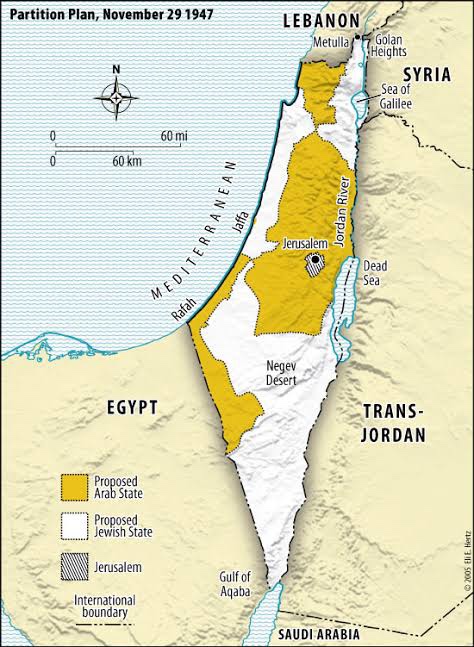
As the refugee crisis escalated, Britain submitted the matter to the United Nations, where the UN General Assembly on 29 November 1947 voted to partition the territory of British Palestine into 2 new states, one Arab state and one Jewish state.

Image by mythsandfacts.org

Dubbed the UN Partition Plan of 1947, it assigned 56% of the land to the Jews and 44% to the Arabs (despite being 66% of the total population). Meanwhile, out of the 56% land given to the Jews 80% of it was already owned by Palestinians, thus a massive scale of land snatching and expulsion of its residence will need to occur. The plan was readily accepted by the Jewish Zionist leaders but strongly rejected by Arab leaders. As a result, a war then broke out between 30 November 1947 and 14 May 1948, during which the British quietly organised their withdrawal from Palestine.

And then on 14 May 1948, Britain officially withdrew from Palestine without leaving any successor and without any solution for the ongoing war. And on the same day David Ben-Gurion – the Executive Head of the World Zionist Organisation and the Chairman of the Jewish Agency for Palestine – unilaterally declared independence for a newly formed country Israel, with Ben-Gurion became its first Prime Minister.

Nakba

On 15 May 1948, just one day after Israel’s declaration of independence, the civil war escalated to become a war between Israel and the Arab states, where Egypt, Transjordan, Syria, and Iraq immediately entered the formerly known as British Palestine and took control of the Arab area, as well as attacking Israeli forces and several Jewish settlements, a war that lasted for 10 months.

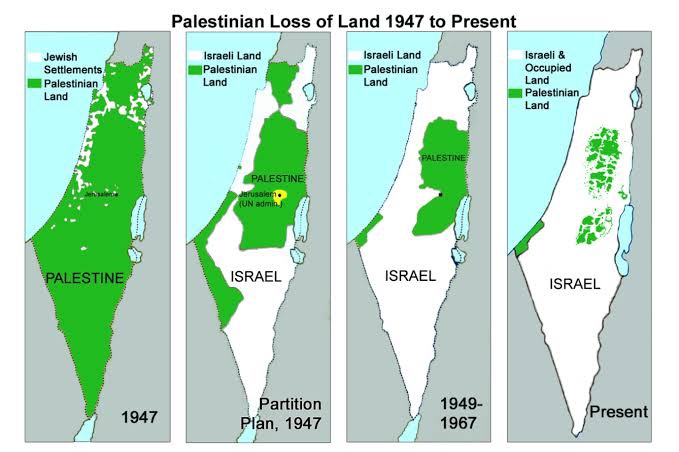
And when the war was over, with Israel as the winner, the Israelis ended up controlling the area that was given to them in the UN Partition Plan 1947, as well as almost 60% of the area that was supposed to be given to the Palestinians. Including the Ramle, Lydda, Upper Galilee and Jaffa area, some parts of the Negev and a wide strip along the Jerusalem-Tel Aviv road. Israel also took control of West Jerusalem, which was initially supposed to be an international zone.

Moreover, around 80% of Palestinians (720,000 out of 900,000) who lived in the territory given to the Jews were thrown out from their homes, through systematic expulsions of around 500 Arab villages and through attacks towards its people by members of Haganah and Irgun troops.

This event became known as Nakba (Arabic for “catastrophe”), an ethnic cleansing of Palestine.

A massive exodus of 688,000 Jewish immigrants then came from Europe and elsewhere to Israel in the first 3 and a half years since Nakba, which more than doubled the 650,000 existing Jewish population at the time. And the Zionist dream that was declared in 1917 has finally been achieved. At the expense of the native Palestinians.

Image by Left.eu

The incredible life story behind Indonesia’s best literature

“Indonesia Out of Exile: How Pramoedya’s Buru Quartet Killed a Dictatorship” by Max Lane

Perhaps the only thing better than the Buru Quartet, is the story behind the making of the Buru Quartet.

On 30 September 1965, a coup occurred in Indonesia. All the military generals were rounded up and slaughtered, while the movements of Indonesia’s highly popular president Soekarno was restricted and he was practically stripped off his power. The killings of the generals were officially [falsely] blamed on the Indonesian Communist Party (PKI) with a retaliative genocide took place not long after, towards the communist party members (killing estimated 1-2 million people), while the intellectual Left were all captured and exiled to a faraway island in Eastern Indonesia, the Buru Island. Including author Pramoedya Ananta Toer.

This book provides the life’s story of Pramoedya, his political views, his innermost thinking, and the reason why he was eventually imprisoned for 14 years by the regime that staged the coup, the Suharto regime. The book is also the story of two other incredible men: Hasjim Rachman, a fearless publisher that became the leader of morale inside his prison in Buru Island. And Joesoef Isak, an international journalist that risked his life for smuggling daily news into his own prison camp in Jakarta to keep the fellow prisoners well informed with the changes in the country.

These men’s stories are told in the most crystal clear context alongside the Indonesian history: The fight for independence, the turbulent 1950s, and the crucial roles the 3 men had in trying to build Soekarno’s vision of Indonesia from journalism and writing.

And perhaps most crucially it tells the little-known story of how the intellectual Soekarnoists (the intellectual Left) were treated and shunned from society after the 1965 coup, by the CIA-backed Suharto regime. The torture and hard labour in Buru island, the corruption of the officers, the injustice imprisonment without trial, all of which provides the rich context for Pramoedya’s idea for his book “Bumi Manusia” (or the “Earth of Mankind”) and its 3 sequels, which together are dubbed the “Buru Quartet.”

In the book, Pramoedya’s dark experiences were channeled into the simple enough beginning of the story. Story that grows immensely complicated, with a deep message of resistance against the colonial rulers, through the historical fiction of Indonesia in the 1890s when it was still the Dutch East Indies under the colonial rule of the Netherlands.

In Buru, Pramoedya was restricted from any access of pen and paper, so instead the entire story was created inside his head and recited to other prisoners in the barrack, in the veranda, and in the hut at night, which quickly became a hit on the island.

The incredible character of Nyai Ontosoroh, in particular, became the prisoners’ favourite. Because she defies the odds and able to rise up from a simple village girl sold to the Dutch master by her father to become a powerful lady in charge of a corporate empire that she has built. Before long, people would quote her dialogues, and the strong character that she has developed and earned along the years inspired the prisoners and raised their spirits.

A similar act of courage also seen in the real life of the 3 men, after they were released from prison. In the environment where Suharto’s presidency was increasingly dictatorial, with plenty of newspapers were censored and even shut down, the three men decided to create a publishing company – Hasta Mitra – to publish Pramoedya’s books that are filled with inspirations to defy a ruler.

It has an air of romanticism in it, where the original manuscripts of “Bumi Manusia” were first written in Buru Island after a compassionate move by one of Suharto’s visiting general finally gave Pramoedya access to a typewriter. The manuscripts were then copied by fellow prisoners in the Island and some were smuggled out with the help of a friendly priest, all of which then came back to Pramoedya’s hand once he returned to Jakarta.

It was with these manuscripts that Joesoef began to work his magic as the editor and publisher, as he set up shop in a tiny room inside his own house. And it was in this cigarette-smoke-filled room full of books that Hasta Mitra made an impact in the 1980s on Indonesian historical process. It answered, as the author Max Lane remarks, “the yearning for that dignified and developed national subjectivity evolving before 1965, through struggle and contestation, in many ways breaking from the past. It was stirring the yearning for a different Indonesia.”

Meanwhile, Hasjim Rachman, in his capacity as the publisher, mobilized all the capital he could find to produce the books, including selling some of his own stuff. And so at last, the books are being published.

But it was of course, never meant to be easy. Soon after “Bumi Manusia” was published in August 1980, not long after it was sold out after just 2 days, the Attorney General informally told them not to distribute the book. But they decided to still go ahead publishing the book, and distribute them in 3 days from Friday to Sunday, before, as dictated by the rules, they had to submit two copies of the book 48 hours of working days to the Attorney General office for “inspection.” And when they were indeed prohibited to publish the book, they already sold 10,000 copies within 2 weeks and 60,000 copies in 10 months. Something unread of back then.

This book then took a great length showing just how exactly “Bumi Manusia” was unofficially prohibited, through ridiculous process of summoning and accusing the book of having a communist theme (it doesn’t) which evidently shows that the government officials who wanted to ban the book haven’t even read the book. Or in other case, the government is pressuring Joesoef to burn all copies of the book (but off record, the government official said he loved the book and even had the audacity to ask to spare 1 copy for his wife to read). Indeed, the men endured harassments, intimidations, and a sudden turnaround from incredible reviews to a government-engineered bad reviews at the press.

And then 9 months after its publication, on 29 May 1981 “Bumi Manusia” was officially banned, along with its subsequent sequels in the upcoming months: “Anak Semua Bangsa” was published in December 1980, banned in May 1981. “Jejak Langkah” was published on 1985, banned in May 1986. And its forth and last sequel “Rumah Kaca” was banned in 1988. Moreover, in 1983 “Bumi Manusia” appeared in English language as “This Earth of Mankind”, published by Penguin, distributed in Australia, Singapore, and United Kingdom, and translated by none other than this book’s author, Max Lane. This was also seen as an act of defiance against the government, which got Lane into trouble, where he consequently got deported for it.

But the books never really disappeared. Despite thousands of copies were confiscated and burned they re-appeared in photocopied version and circulated widely in secret. Indeed, the publishing of the books then went guerilla underground. That is, until the fall of Suharto in 1998 – another traumatic event in Indonesian history akin to 1965 that is told extensively in this book – when the books are finally free to be published for the public, and once again became the voice of reason during the post-Suharto Reformation era.

Chapter 12 of the book is an extensive analysis on this voice of reason, that dive deep into the philosophy behind the “Buru Quartet.” They raise an important issue that have been discussed throughout this book: the question of the identity of the nation. Which, according to Pramoedya, Hasjim, Joesoef, and indeed the 4th member Max Lane himself always said, the Indonesian identity is not yet fully developed, that we still in the process of finding out the true colour, finding out our national identity.

As Pramoedya remarks, “The era of Sukarno and the Trisakti doctrine was nothing but a sort of thesis. The New Order, an antithesis. Therefore, for me, it is something that in fact cannot be written about yet, a process that cannot yet be written as literature, that does not yet constitute a national process in its totality, because it is in fact still heading for its synthesis. While I was still at Buru, an Indonesian.”

Today, the three men have long passed away, with Hasjim died in 1999, Pramoedya in 2006, and Joesoef in 2009. And it is perhaps the greatest literary tragedy that the “Buru Quartet” is still not commonly read in Indonesia, except for a brief period of time at the beginning of the Reformation and by the niche few today. It is not even widely distributed, as we cannot find them readily available at the usual chain bookstores. And once I can get my hands on them, they were the photocopied version from a used book store, because Hasta Mitra closed down not long after Hasjim passed away and its successor publisher Lentera Dipantara (founded by Pramoedya’s family) has recently stopped printing Pramoedya’s books.

It is such a pity that the greatest Indonesian literature ever written, and indeed the greatest books I’ve ever read, are buried under the pile of broken idealism for Indonesia. That over time history could possibly forget about these men and their ideas for the country. And that Indonesians won’t even know what they are missing.

Especially considering that after publication its English translation was immediately listed as Top Ten Bestsellers in the Sydney Morning Herald for several weeks, in Singapore they needed to print extra batches of copy to meet the exploding demand, in the US a book review at The Washington Post called the book “the Indonesian Iliad”, while Pramoedya himself has won more than a dozen international awards thanks to the books. But yet, appallingly, he has not won a single award in his own country Indonesia.

But then again, the official ban on these books has never been formally lifted.

More on Buru Quartet: Book 1|Book 2 | Book 3 |Book 4

The blueprint behind Chuck Palahniuk’s Punk rock writing style

“Consider This: Moments in My Writing Life after Which Everything Was Different” by Chuck Palahniuk

Chuck Palahniuk is a unique human being. He has this unorthodox way of thinking that is really out of the usual norm and even considered as dark and twisted. It is reflected in his many work that includes 19 novels, 3 non-fiction books, 2 graphic novels, 2 adult coloring books, and a handful of short stories in between.

This book is an excellent sneak peak on that: his thought patterns and the way he sees things, which show the reasonings behind his weird but wonderful stories, stories that he observed as similar like the typical punk rock music that starts strong, very loud, and finish abruptly before you know it.

The book, however, is not your typical memoir. Yes there are bits and pieces about his life every now and then, but the main focus of the book is his writing journey, the drawing board behind his masterpieces. All those technicalities on writing and publishing are covered, which makes reading it like talking with a football coach about the specific parts of strategies, or watching a movie with a director’s commentary.

In several chapters he breaks down the art of writing into very specific parts and use a huge library of examples to make his points, with the relevant scenes from books and movies.

Specifics, such as how to dictate the speed of the writing, how to fill in the gap between 2 scenes, on creating memorable dialogues, how to use page breaks, avoiding the common mistake to give away everything at the opening sentence, on creating and curbing tensions (the stripper and the comedian), how to create new rules in the story and repeat them, how to submerge the “I”, how to crowd seed a writing idea, using head authority or heart authority, on character developments occurring through the little choices they make, or how to find imperfections in nonfiction form and use them to make our fiction seems more real and less polished. He even create his own grammar rules at some of his books. Yup, as I said, out of the usual norm.

He also dwell deep into the many techniques to do special effects in the flow of writing, like the vertical and horizontal expansion of a story development, on using what he calls the clock versus the gun, or even putting a page number backwards with the end at page 1 in order to create extra tension. I never knew that there are so many writing ways to create something like a sound effect or camera tricks in a movie. His example on how he build up his story from merely his dog’s sadness when the dog sees his suitcase, to a dark twist where a child is trapped inside the suitcase, is a prime example for this.

Moreover, I love the way he describes his process of creating a writing from zero, to first draft, to the many drafts afterwards where he’s making ongoing notes, bounce off ideas with his trusted people to close some gaps or loopholes, perfecting it as he goes like painters perfecting their art, and tweaking the pace and ending. He also shows how he can draw inspirations from the menial day-to-day tasks or from the unlikeliest places such as a magazine, his laundromat, the 4th step of the AA meeting, or a seminar for used car salespeople.

The book also discusses anything that surrounds the process of writing, such as having a complete stationaries or logistical tools for writing, having a support group of fellow writers and mentors, and addresses difficult issues such as book piracy, copyright violations from the fans, scams and traps from people who wants to claim that we stole their ideas, on book tours, and the many incredible stories about his interactions with his fans that can teach us one or two things.

Indeed, there is arguably no other book on writing that provides us with the blunt honesty about writing and its world than this book. And there are so many advices told after the line “If you were my student…” which makes this book the closest thing to attending Chuck Palahniuk’s writing classes in person. The last chapter in particular, where he provide a table of all the tips and tricks to troubleshooting our writing, is superb and forces us to think about writing (and view the world in general) in a whole different way, a fresh and unique way.

I like him, he’s brilliant but nuts.

Charles Bukowski at his rawest

“Notes of a Dirty Old Man” by Charles Bukowski

Charles Bukowski doesn’t pretend to be a saint. He’s more of a rock-and-roll type of person that has surrendered to his vices and even has that hint of proudness of his shortcomings. Heck, he literally called himself a dirty old man, which is fitting with all the misogyny and perverted comments.

We all know that type of old man, a blunt and sarcastic one who have seen it all and tired of all the bullshit. Which makes for a hilarious companion, where we tend to stick around near him and cannot wait to see what he will say or do next, but never want him to be anywhere near our children.

This book is exactly that, a series of few dozens short essays that represent Bukowski’s most mischievous observations on society, some fictions, some weirdest true stories, some blurry between real or not, but mostly the greatest hits from the collection of his underground newspaper columns with the same name – Notes of a Dirty Old Man – for the Open City newspaper (which prompted the FBI to keep a file on him).

It is part autobiography, part crude comedy filled with alcohol, women and bizarre adventures, written in a 1960s style of conversation.

The book serves to show that the immortal writers with their masterpieces are humans after all, and sometimes their life’s story are even more amusing than their work. Which makes the book weirdly enjoyable, because it is so damn uncensored and raw, a blend of honesty and bat-shit crazy that makes a brilliant read.

The long backstories that leads to the phrase “I once lost a million dollar to a Japanese fisherman” or “eating a small animal with a tiny asshole” or “cold shit, warm shit, it’s still shit” are some of the standouts. Chapter 33 in particular is superb, filled with one liners inspired when he was drunk. Lines such as:

  • When love becomes a command, hatred can become a pleasure.
  • If you don’t gamble, you’ll never win.
  • Beautiful thoughts and beautiful women never last.
  • You can cage a tiger but you never sure he’s broken, men are easier.
  • If you wanna know where God is, ask a drunk.
  • There aren’t any angels in the foxholes.
  • No pain means the end of feeling. Each of our joys is a bargain with the devil.
  • The difference between art and life, is that art is more bearable.
  • I rather hear about a life American bum than a dead Greek God.
  • There is nothing as boring as the truth.
  • The well-balanced individual is insane.
  • Almost everybody is born a genius and buried an idiot.
  • A brave man lacks imagination, cowardice is usually caused by lack of proper diet.
  • Sexual intercourse is kicking death in the ass while singing.
  • When men rule governments men won’t need governments, until then we are screwed.
  • An intellectual is a man who says a simple thing in a difficult way. An artist is a man who says a difficult thing in a simple way.
  • Every time I go to a funeral I feel as if I had eaten a puffed wheatgerm.
  • Dripping faucets, farts of passion, flat tires are all sadder than death.
  • If you want to know who your friends are, get yourself a jail sentence.
  • Hospitals are where they attempt to kill you without explaining why.
  • The cold and measured cruelty of the American hospitals is not caused by doctors who are overworked or who have gotten used to and bored with death. It is caused by doctors who are paid too much for doing too little. And who are admired by the ignorant as witch men with cure when most of the time they don’t know their own arsehair from celery shreds.
  • Before a Metropolitan Daily exposes an evil it takes its own pulse.

But one line from chapter 12 haunts me the most, until chapter 42 and even after I finished the book. It is one of the more serious parts of the book, on war and politics: “Revolution sounds very romantic, you know, but it ain’t. it’s blood and guts and madness; it’s little kids killed who get in the way, it’s little kids who don’t understand what the fuck is going on. it’s your whore, your wife ripped in the belly with a bayonet and then raped in the a** while you watch. it’s men torturing men who used to laugh at Mickey Mouse cartoons.”

Ryan Holiday’s most Robert Green-esque book

“Conspiracy: A True Story of Power, Sex, and a Billionaire’s Secret Plot to Destroy a Media Empire” by Ryan Holiday

This is a story of a war strategy. It is a great battle of tactics in the field of law, between an untouchable antagonist and a secretive protagonist. This is a story of a conspiracy.

“Conspiracy entails determined, coordinated action, done in secret—always in secret—that aims to disrupt the status quo or accomplish some aim”, explains Holiday. And it was this secretive strategy that eventually prevails where nobody else before them succeeded.

This story begins with a take-down post at a notorious gossip blog owned by Gawker Media.

Now, Gawker is no saint. Founded in 2003, they are central to many nasty publications from celebrity sex tape to copyright leaks to framing public opinions on hot controversial topics, and all done while hiding behind the First Amendment on freedom of speech. This is a media who early in the game already uses clickbait and pay writers by the traffic, and “turn writing, social commentary, and journalism into a video game.”

But little did they know that their one blog post on 19 December 2007 – which reveals that the private and secretive protagonist is gay – would ripple into a world of chaos for them for almost a decade. Yes, a decade.

As Holiday remarks, “Machiavelli said that a proper conspiracy moves through three distinct phases: the planning, the doing, and the aftermath. Each of these phases requires different skills—from organization to strategic thinking to recruiting, funding, aiming, secrecy, managing public relations, leadership, foresight, and ultimately, knowing when to stop. Most important, a conspiracy requires patience and fortitude, so much patience, as much as it relies on boldness or courage.”

This is exactly how the story develops – slowly, patiently, with lots of calculations. And this is how the book is also organised, where at each step of the way Holiday draw parallel to strikingly similar occasions in history, so much so that it feels at times that I’m not reading a Ryan Holiday book but rather his mentor’s Robert Greene.

No more spoiler, because the story is so gripping with secret planning, setbacks, and several plot twists along the way, with an ending revealing a genius plan that could well be the plot in the series Money Heist.

But I can safely tell you that it teaches us a lot about the step by step process of a lawsuit in the US and the intriguing courtroom strategies to win over the hearts and minds of the jury. And perhaps most importantly is the ending of this saga, which I learned from the most, where the Romans often refer to as the Gallic Way.

Ryan Holiday has a unique vantage point for writing this story, because he had a direct access to abundant of information from both sides or the war, including from the main antagonist and protagonist. And he has repeatedly said that of all the dozen+ books that he has written, this one is his favourite to write and even claimed that this is his best work. I can see why. It’s an absolute masterpiece.

Book 4 of 4 of the best literature ever written in Indonesian language

“Rumah Kaca” by Pramoedya Ananta Toer

5 pages into the story, this 4th and last book of the Buru Quartet already provides some unexpected realisation: the narrator is now different! And it’s really intriguing knowing who this person was in book 3, and how it ended between this person and Minke. It truly gives that ending another angle, now with the background story from the opposite vantage point before that crucial ending.

The book then elaborates on life in the Dutch East Indies, from the ruler’s point of view. It covers the governor general, the many roles of the officers, the inner conflicts between humanity and enforcing injustice colonial law, the intermittent vacuum of power during when Netherlands was involved in World War 1, and of course – continuing the narrative from book 3 – the many different organisations that spring up among the locals.

Indeed, here at book 4 everything that were building up in book 3 are already in full force. The figurative fire is spreading nationwide and cross-countries, and it looks so damn terrifying from the vantage point of the colonial ruler. It also has a brilliant element of doubts instilled in the narrative, and conflicting dilemmas in between nostalgics from the past books. And just as book 1-3, the story is so hard to predict and full with surprises.

Oh there are so many things from this book that I wanted to share more but afraid to spoil anything. But let’s just say, the ending of the book makes me understand why in real life Pramoedya Ananta Toer was jailed by the Dutch, jailed by Soekarno, and was sent to exile in Buru Island by Soeharto. And it’s astonishing how it was just like the actual story of Tirto Adhi Soerjo, the real-life inspiration for the character Minke.

All in all, there are 535 pages for Bumi Manusia, 536 pages for Anak Semua Bangsa, 721 pages for Jejak Langkah, and 646 pages for this one Rumah Kaca. This work has won 11 awards, with Pramoedya himself was awarded with 7 more honours.

Now I’ve read Hemingway, I’ve read Shakespeare. I love Coelho and was pleasantly surprised by Voltaire. Huxley and Orwell gave me the creeps, with the former in a good way and the latter in a bad way. I’ve read Twain’s classics, two in a row, Thoreau’s overrated musings about isolation, got lost in Tolstoy’s big-ass book, and got carried away by a little known Southern classic by Walker Percy.

But nothing, I mean NOTHING, compares with the Buru Quartet. It easily becomes my absolute favourite literature, and most possibly my favourite book ever out of 558 that I’ve read so far.

More on Buru Quartet: Book 1| Book 2 | Book 3 | The making of Buru Quartet

The non-fiction rants by Orwell

“A Collection of Essays” by George Orwell

George Orwell (1903-1950) is world famous for his novels, most notably 1984 and Animal Farm. And as a big reader of non-fiction books I was pleasantly surprised when I discovered that he wrote a series of non-fiction essays, 2 dozens+ short stories that dive deep into his world views and opinions.

However, you know that expression never meet your hero? Well this is kind of like that, never read the real-life thoughts of your fiction-writer hero. Because it is just God-awful. It is full with rants and criticism towards seemingly everyone in his childhood, towards the English language, as well as filled with all the negative things he has been holding in for fellow writers such as Charles Dickens, Henry Miller, Rudyard Kipling, and many more. And the awful things he says about Mahatma Gandhi? What a dickhead.

To be fair, it’s not all bad, the essays on his experience at the Spanish War are insightful. The essay on why he writes, almost single-handedly makes the book so much better. And the essays on his time in Marrakech and Burma are quite interesting, although the former reveals his racist views on Africans and the latter shows a terrible colonial racism mentality that he apparently has. A “man of his time” indeed.

Needless to say, apart from few 4-stars essays there are loads of crappy 2-stars gibberish to counter balance the value of the book. And this, in the end, is the reality of his real thoughts. Truly disappointing for a man of his stature.

Book 3 of 4 of the best literature ever written in Indonesian language

“Jejak Langkah” by Pramoedya Ananta Toer

After the introduction in book 1 and the build up in book 2, now we’ve arrived at the middle of the action. All 721 pages of it.

The story in this book happens far from the scenes of the first 2 books in East Java, in a new scenery in Betawi (or Batavia). It vividly portrays the everyday life of the capital city, the multi-nationalities living there, the tram, automobile, the entertainment venues, and the mash up of cultures. It provides a new environment for our protagonist Minke, in a new 20th century, with new friends, new superiors, new antagonists, a new special friendship with the enemy, an unexpected double agent, and one particular amazing new character in Minke’s life that I would not elaborate because no spoiler. Make it two amazing characters.

And the apartheid reality of the Dutch East Indies portrayed in book no. 1 and 2? It gets escalated, and challenged, in fact, where the cross-culture actions become the main theme of this book. And the secluded events in just few towns in book 1 and 2 become a cross-cities events in this book, scaling up from local events to national events.

The book also get wonderfully entangled with global current affairs, where the situation in the Dutch East Indies is both directly and indirectly affected by the liberal movement in Europe, the Russian-Japan war, the China-Japan war, the British triumph over the Boer in South Africa, the spread of diseases, etc. It also put a special attention to colonialism as seen by the coloniser, as a saviour or moderniser, with compelling arguments that add to the complicated mix of day to day life in the occupied land.

Moreover, the book specifically highlights the vital importance of the media, how news is being told and interpreted through various vantage points, about the target audience of the media that represent certain demography or race, about the organisation that works behind the scene of a media and/or the organisation that uses media as the mouthpiece or their ideology, how ideas can slowly be taught and cultivated in the readers’ mind, and of course in this context, how national movements can be ignited and mobilised from the lessons taught and news told from the media, and the struggles from the backlash over their success (which simply means resistance from the ruling powers and a lot of encounters with law enforcement and intimidations, even murder attempts).

The character development of the protagonist is also noteworthy. It’s astonishing how Minke really did have to go through all the things in book 1 to book 2 and the first 1/3rd of book 3, in order to shape him into the person he becomes, which is very crucial for what about to happen in the rest 2/3rd of book 3. All that experience and knowledge that he has gained, has made him see everything that are really going on in the Dutch East Indies. Everything, from the injustice, the bribery, the covering up, even the politics within the Dutch government in East Indies, at the backdrop of an increasingly burning nationalism.

The book also touched so many real-life history of the birth of local organisations and the fascinating struggles to build them, on trade and commerce, on local politics, on the very complicated law and regulation in the Apartheid society, on breaking old customs, on gang wars, the fight against the powerful cartel, on the everyday interactions in the wonderfully multi-layered society, and many other aspects that give a big picture feel of the Dutch East Indies.

I especially love the letters montage in the middle of the book and near the end, and the small details such as the recurring characters from book 1 and 2 that he accidentally bump into on the road, or met in a much different luck, or simply re-appears on memory.

And that ending? Holy crap! Like any great stories, I really cannot guess where it will lead next.

More on Buru Quartet: Book 1 | Book 2 | Book 4 | The making of Buru Quartet