How the state of Israel was created
Have you ever wondered why the flags of the Arab countries all look similar?

It was World War 1 (1914-1918), with over 30 countries divided into 2 sides: the Allied powers with the likes of Britain, France, Russia, Italy, Serbia and the United States. And Central Powers that consist of Germany, Austria-Hungary, Bulgaria and the Ottoman Empire. One of Allied’s war tactics was to destroy the Ottoman from the inside, by funding a revolution in its Arab provinces (a role romanticised by Lawrence of Arabia, a British spy). And they were all organised under 1 flag, the Arab Revolt flag.
Another Allied tactic was to gather war support from the Jewish community in Britain, in exchange for the realisation of the Zionist aspiration to establish a Jewish national home in Palestine:
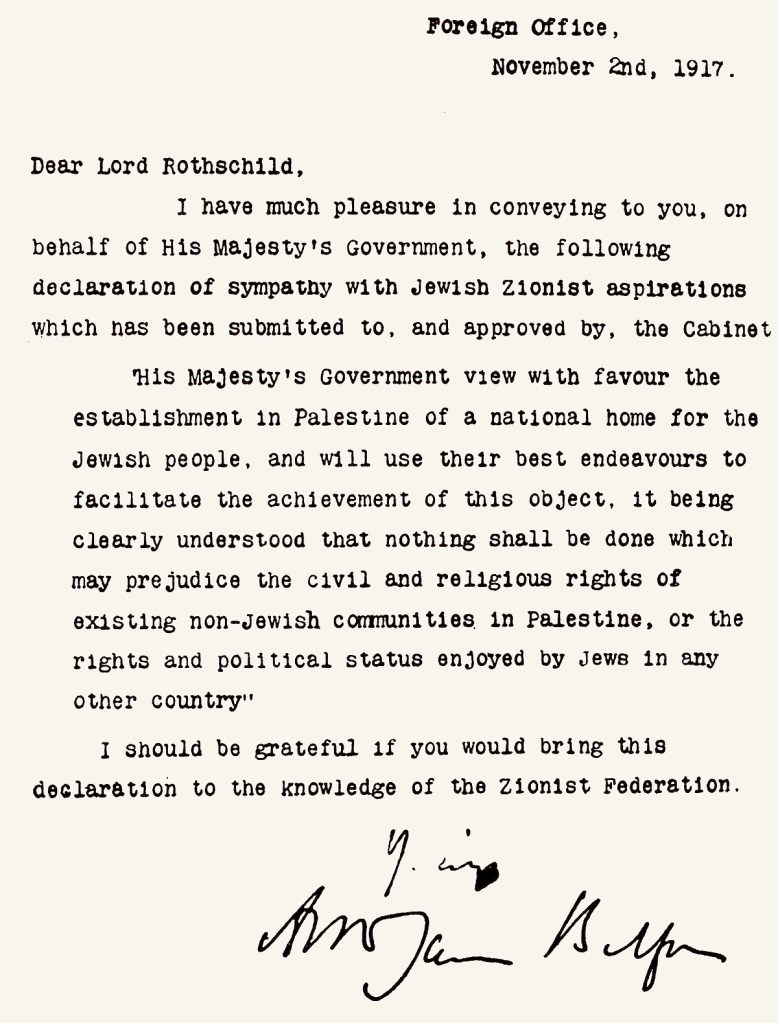
This has since dubbed as the Balfour Declaration 1917.
In the midst of the war, between November 1915 – March 1916, British diplomat Mark Sykes and French diplomat Francois Picot negotiated on behalf of their respective countries, and resulted with the Sykes-Picot Agreement 1916 that drew the map of the Middle East into British-rule, French-rule and Russia-rule. Before they even won the war. The initial plan looked like this:
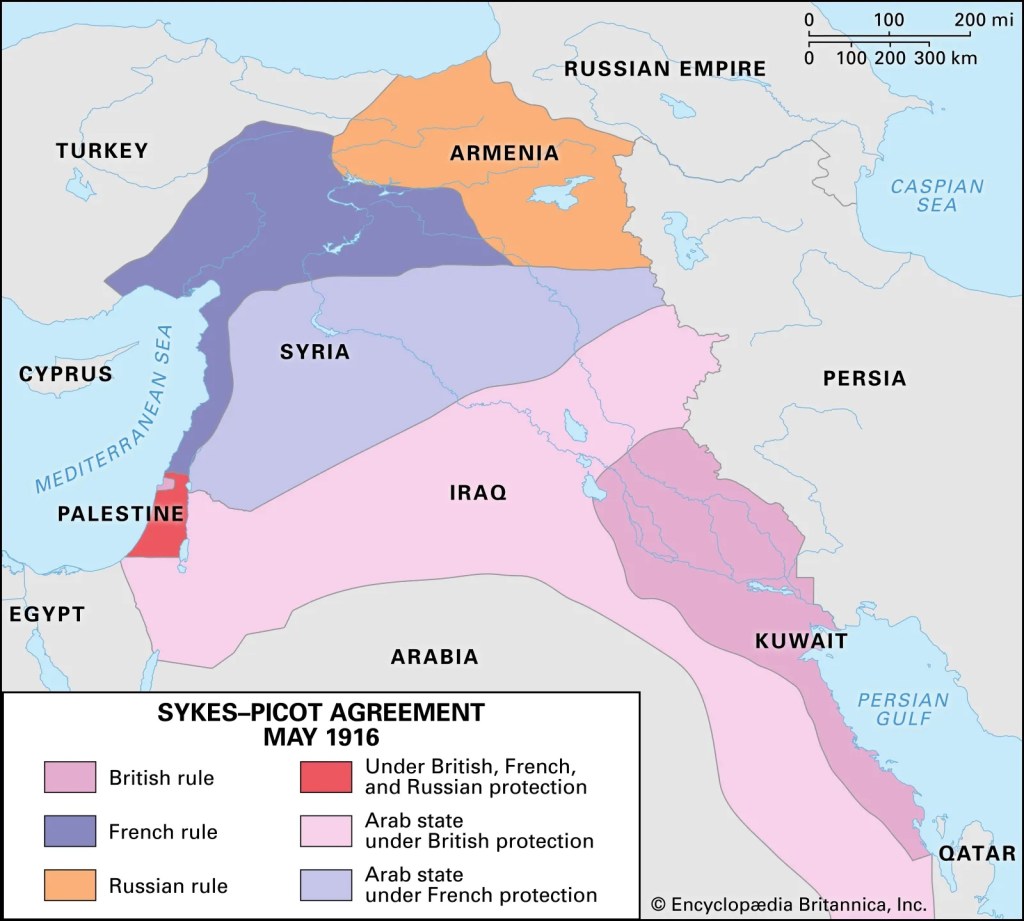
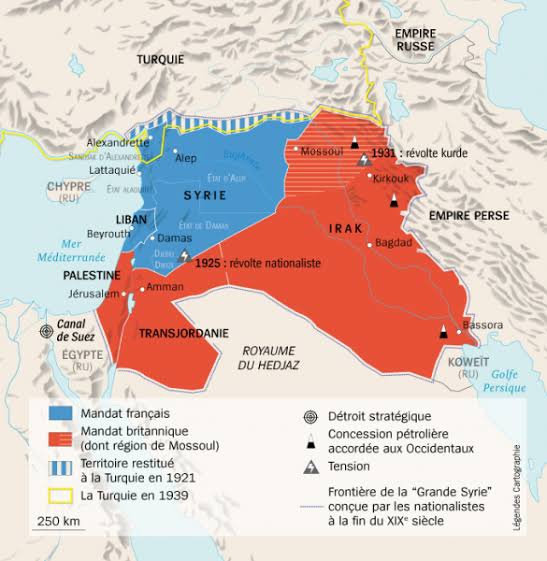
But then a lot of things happened during the war, including the Russian Revolution and the Turkish War of Independence, which changed the balance of power and the distribution of land prizes when the war was over (and the Ottoman Empire being dismantled). Another agreement was needed, and so the Conference of San Remo took place in 1920. Which gave the blue area to France, and the red area to Britain (including Palestine).
Prior to this, World War 1 was formally ended in a truce but the majority of the war reparation was imposed upon Germany which was formalised in article 231 of the Treaty of Versailles 1919. The payment of this reparation was done through recklessly printing money, which would debase their currency and eventually cause hyperinflation in the next few decades in Germany.
Meanwhile, following the Conference of San Remo, the British mandate of Palestine was formalised in 1920 by the League of Nations (the precursor of the United Nations) in a special article in its legislations. And the person that Britain put in Palestine as its first high commissioner? A British Jewish Zionist by the name of Herbert Samuel.
Moreover, the economic woes in Germany got worse after the Great Depression in the 1930s where hundred of thousands became unemployed and starving. People needed a saviour from this hellhole and a reason for their misery, and Adolf Hitler provided both. In his bid for power, Hitler use speeches that scapegoated the Jews – or more specifically the “international Jewish bankers” who were present in the Treaty of Versailles – for all this mess and rallied the crowd behind him.
While the Nazi party was not a major force in German politics in the 1920s, on 31 July 1932 election they became the largest party in the Reichstag (the parliament), on 30 January 1933 Hitler was formally appointed as Germany’s new Chancellor, on 5 March 1933 (just 6 days after the Reichstag Fire) the Nazis won the election that gave them control over the Reichstag, Hitler then convinced President Paul von Hindenburg to pass the Reichstag Fire Decree and later the Enabling Act of 1933 that gave Hitler emergency powers to pass and enforce laws without parliamentary oversight, and Hitler’s dictatorial powers was complete when following the death of von Hindenburg Hitler, using his emergency power, merged the chancellory with the presidency and became the Führer, the sole leader of Germany.
During this time, British Palestine in the 1930s was a turbulent place where after a decade of oppression and discrimination, a Palestinian uprising eventually occurred in 1936 against the British Zionist administration, with people demanded independence (as promised during the Arab Revolt) and the end of the policy of open-ended Jewish migration and land purchases. At that point the migration was well under way, where under British occupation the Jewish population in Palestine have grown from 57,000 to 370,000 by 1936 (increasing the population share from 17% to 27% along the growth of Palestinian birth).
The Palestinian uprising ended in failure in 1939, however, and the British then gave a critical backing to Zionist militant group Haganah, which have protected Jewish settlers in Palestine since Britain got its international seal of approval in 1920 to colonise the land.
The year 1939 was also a critical year in Germany, where after 6 years of Apartheid law imposed against the Jews, the harassments and blatant discriminations became increasingly violent. And then on 1 September 1939 Hitler invaded Poland, triggering a declaration of war from Britain and France that would quickly escalate into World War 2 that eventually involved 70 countries taking part in the conflict between 1939 and 1945. The same period also saw a massive-scale of population displacement in an unprecedented proportion, and the killing of 25 million military personnels and 50 million civilians (including 6 million Jews).
When the war ended in 1945, many surviving Jews resided in the refugee camps called Displaced Persons (DP) camps. At its peak in 1947 the population in these camps reached 250,000 people, but it was never intended to be permanent homes. And thus plenty of refugees were desperate to leave. But where to?
As the refugee crisis escalated, Britain submitted the matter to the United Nations, where the UN General Assembly on 29 November 1947 voted to partition the territory of British Palestine into 2 new states, one Arab state and one Jewish state.
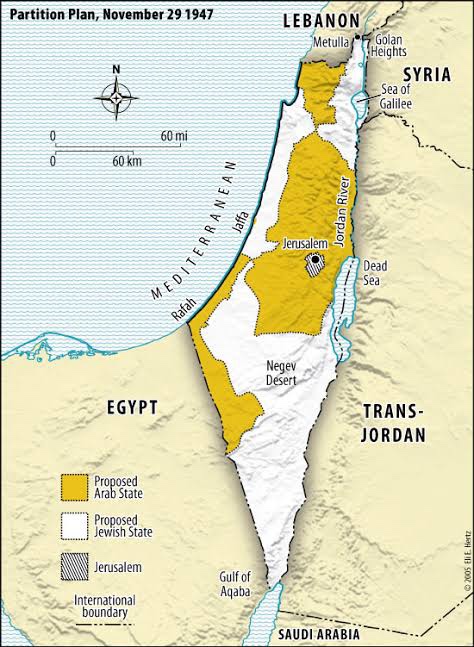
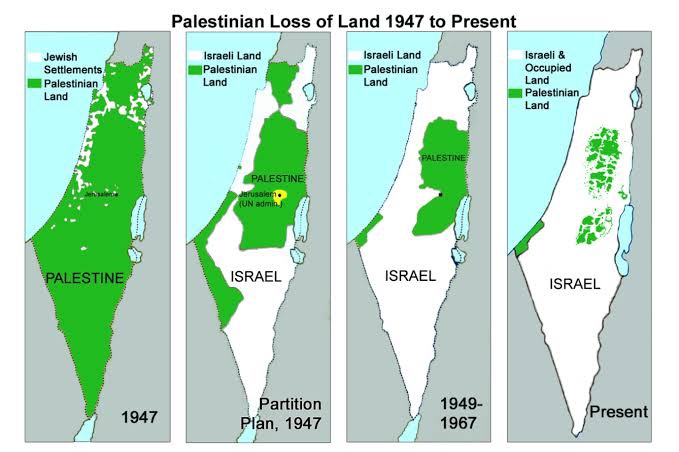
Dubbed the UN Partition Plan of 1947, it assigned 56% of the land to the Jews and 44% to the Arabs (despite being 66% of the total population). Meanwhile, out of the 56% land given to the Jews 80% of it was already owned by Palestinians, thus a massive scale of land snatching and expulsion of its residence will need to occur. The plan was readily accepted by the Jewish Zionist leaders but strongly rejected by Arab leaders. As a result, a war then broke out between 30 November 1947 and 14 May 1948, during which the British quietly organised their withdrawal from Palestine.
And then on 14 May 1948, Britain officially withdrew from Palestine without leaving any successor and without any solution for the ongoing war. And on the same day David Ben-Gurion – the Executive Head of the World Zionist Organisation and the Chairman of the Jewish Agency for Palestine – unilaterally declared independence for a newly formed country Israel, with Ben-Gurion became its first Prime Minister.
Nakba
On 15 May 1948, just one day after Israel’s declaration of independence, the civil war escalated to become a war between Israel and the Arab states, where Egypt, Transjordan, Syria, and Iraq immediately entered the formerly known as British Palestine and took control of the Arab area, as well as attacking Israeli forces and several Jewish settlements, a war that lasted for 10 months.
And when the war was over, with Israel as the winner, the Israelis ended up controlling the area that was given to them in the UN Partition Plan 1947, as well as almost 60% of the area that was supposed to be given to the Palestinians. Including the Ramle, Lydda, Upper Galilee and Jaffa area, some parts of the Negev and a wide strip along the Jerusalem-Tel Aviv road. Israel also took control of West Jerusalem, which was initially supposed to be an international zone.
Moreover, around 80% of Palestinians (720,000 out of 900,000) who lived in the territory given to the Jews were thrown out from their homes, through systematic expulsions of around 500 Arab villages and through attacks towards its people by members of Haganah and Irgun troops.
This event became known as Nakba (Arabic for “catastrophe”), an ethnic cleansing of Palestine.
A massive exodus of 688,000 Jewish immigrants then came from Europe and elsewhere to Israel in the first 3 and a half years since Nakba, which more than doubled the 650,000 existing Jewish population at the time. And the Zionist dream that was declared in 1917 has finally been achieved. At the expense of the native Palestinians.
 THE CHAOS THEORY